

The Ultimate Guide to Opal Rings: Types, Colors, and Meaning
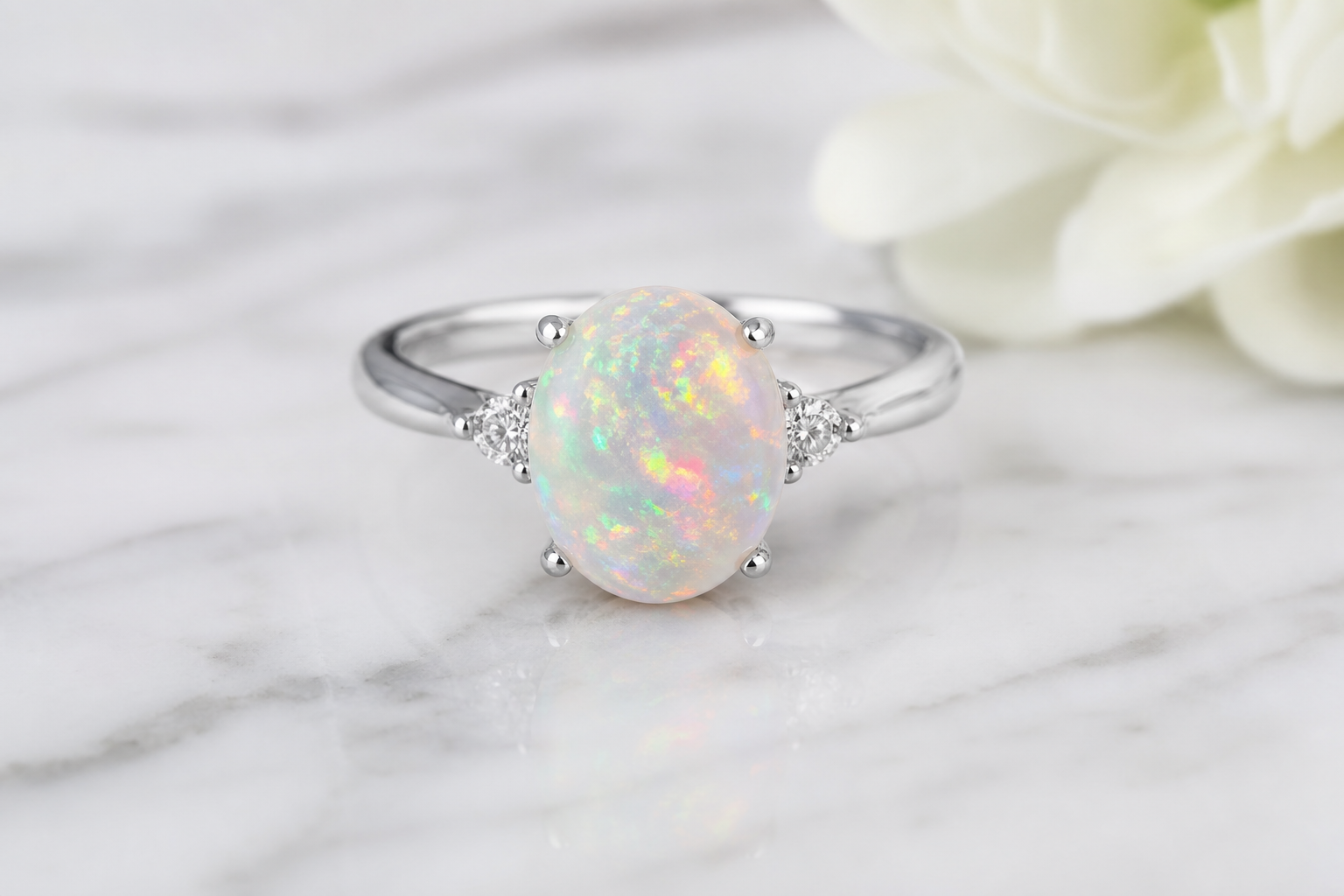
Few gemstones command the same sense of wonder as opal. Hold one up to the light and watch it explode into a spectrum of colors — fiery reds, electric blues, deep purples, and everything in between — all shifting and dancing as you move. This phenomenon, called “play-of-color,” is what makes opals the most magical gemstones in the world. And when set in a ring, an opal becomes a wearable piece of living light.
But opals are more than just beautiful. They come in many varieties, each with distinct characteristics, price points, and care requirements. This guide will walk you through everything you need to know about opal rings, from the science behind their mesmerizing colors to how to choose, wear, and care for your stone.
The Science of Play-of-Color
Opal’s play-of-color isn’t a surface effect — it’s built into the stone’s very structure. Opal is composed of billions of microscopic silica spheres packed tightly together. When light enters the stone, it diffracts through these spheres, splitting into the colors of the rainbow. The size and arrangement of the spheres determine which colors appear:
- Larger spheres produce reds, oranges, and yellows (longer wavelengths)
- Smaller spheres produce blues, violets, and greens (shorter wavelengths)
- Uniformly sized spheres create narrow bands of color
- Varied sphere sizes produce a broad, vivid spectrum
The intensity and coverage of play-of-color are the primary drivers of an opal’s value. A stone with bright, full-spectrum color covering most of its surface can be worth many times more than a stone with faint, patchy color.
Types of Opals
Not all opals are created equal. Here are the main varieties you’ll encounter in jewelry:
Ethiopian Opals
Ethiopian opals have surged in popularity over the past two decades, primarily sourced from the Welo and Merawi regions. They’re known for:
- Exceptional play-of-color — often more vivid and widespread than Australian opals of similar quality
- Water opal characteristics — many Ethiopian opals have a translucent to transparent body, allowing light to pass through and intensify the color display
- Cotton-like inclusions — small white patches that resemble cotton balls; these are natural and don’t significantly affect value unless they dominate the stone
- Hydrophane nature — Ethiopian opals can absorb water, which temporarily changes their appearance. They may look cloudy when wet but dry clear again. This means you should avoid soaking Ethiopian opals.
Ethiopian opals tend to be more affordable than comparable Australian opals, making them an excellent entry point for opal collectors.
Australian Opals
Australia produces roughly 95% of the world’s precious opals, with major deposits in Queensland, South Australia, and New South Wales. Australian opals are categorized by body tone:
- Black opals — Dark body tone (N1 to N4 on the Opal Color Grading Scale) that makes play-of-color appear intensely vivid. Lightning Ridge is the most famous source. Black opals are the rarest and most valuable.
- Crystal opals — Transparent to translucent body tone with brilliant play-of-color. The clear background lets light pass through the stone, creating a stunning three-dimensional color display.
- White opals — Light body tone (N5 to N7) with subtle, delicate play-of-color. These are the most common Australian opal type and offer a softer, more ethereal beauty.
- Boulder opals — Thin layers of opal grown on ironstone host rock, primarily from Queensland. The ironstone backing is often left visible, creating a striking two-material aesthetic. Boulder opals are naturally thinner and lighter than solid opals.
- Fire opals — While the term “fire opal” is also used for Mexican opals (see below), Australian fire opals from Coober Pedy can display warm body tones ranging from yellow to orange to red, sometimes with subtle play-of-color.
Mexican Fire Opals
Mexican fire opals (primarily from Querétaro and Chihuahua states) are known for their warm body colors — ranging from transparent yellow through vibrant orange to deep cherry red. Most Mexican fire opals do not display play-of-color, though “fire opals with play” are rare and valuable. The most prized Mexican fire opals are those with a saturated, even red-orange color and high transparency. They’re often cut as faceted stones rather than cabochons, which is unusual for opals.
Boulder Opals
Boulder opals are unique in that the opal forms in thin veins within ironstone. Miners cut through the ironstone to expose the opal layer, creating rings that showcase both the opal and its natural host rock. The ironstone backing gives boulder opals a distinctive appearance and makes them lighter and more durable than solid opals of similar size (the ironstone provides structural support).
Other Notable Varieties
- Harlequin opals — A term for opals with large, bold patches of color arranged in a checkerboard-like pattern. This is a quality descriptor rather than a geographic type; harlequin patterns can appear in black, crystal, or white opals.
- Pinfire opals — Ethiopian opals with small, scattered pinpoint flashes of color rather than broad areas of play-of-color. When cut correctly, these can create a dazzling starburst effect.
- Matrix opals — Opals where the opal has grown into the pores of the host rock, creating a web-like pattern. Common in Australian boulder opals.
The 4 Cs of Opal Grading
While the traditional 4 Cs (cut, color, clarity, carat) apply to most gemstones, opals are graded differently due to their unique properties:
1. Play-of-Color (The Most Important Factor)
This replaces “color” as the primary value driver. Grading considers:
- Brightness — How vivid and intense the colors appear. “Bright” is the highest grade.
- Pattern — The arrangement of color patches. Rare patterns like harlequin, rosette, and flag command premium prices. Common patterns include pinfire, mosaic, and broadflash.
- Color range — Stones displaying the full spectrum (red, orange, yellow, green, blue, violet) are more valuable than those showing only one or two colors. Red is the rarest and most prized color in opals.
- Coverage — The percentage of the stone’s face covered by play-of-color. Full-coverage stones are significantly more valuable.
2. Body Tone
Body tone refers to the background color of the opal, graded from N1 (black) to N9 (white) on the Opal Color Grading Scale. Darker body tones (N1–N4) make play-of-color appear more vivid, which is why black opals are so prized. However, a brilliant crystal opal (N8–N9) with exceptional color can be worth more than a dull black opal.
3. Clarity and Transparency
For crystal and water opals, transparency is key — the clearer the stone, the better the light can interact with the silica spheres. For black and white opals, clarity refers to the absence of cracks, clouds, or foreign material that detracts from the stone’s beauty.
4. Cut and Shape
Opals are typically cut as cabochons (domed, polished stones with flat or slightly curved backs) to maximize the display of play-of-color. The dome should be evenly curved without flat spots or “turtle backs” (too flat). Some opals, particularly Mexican fire opals, are faceted. The cut should also consider the stone’s orientation — the play-of-color should be centered and visible when the stone is set in a ring.
Carat weight matters less for opals than for many other gemstones because opals are lightweight (specific gravity of 2.1–2.3, compared to diamond at 3.52). A 10mm round opal weighs approximately 3–4 carats.
Opal Symbolism and Birthstone Meaning
Opal is the official birthstone for October, alongside pink tourmaline. Its symbolism is rich and varied:
- Hope and purity — The name “opal” likely derives from the Latin opalus, meaning “precious stone,” which itself may come from the Sanskrit upala. In many cultures, opal symbolizes hope, purity, and truth.
- Creativity and inspiration — Opal’s ever-changing colors have long been associated with artistic inspiration and creative energy.
- Emotional healing — Many believe opal amplifies emotions and helps release suppressed feelings, making it a stone of emotional honesty.
- Good luck — This is complicated. In the 19th century, Sir Walter Scott’s novel Anne of Geierstein featured an opal that brought misfortune to its owner, creating a superstition that persists today. In reality, opals have been considered lucky for millennia — ancient Romans called them the “gem of gems” and believed they conferred the virtues of all colored stones.
Setting Types for Opal Rings
Opals are relatively delicate (5.5–6.5 on the Mohs scale) and sensitive to temperature and humidity changes, so the setting is crucial:
Bezel Settings (Recommended)
A bezel setting wraps a metal rim around the entire circumference of the opal, providing maximum protection. This is the best setting for everyday opal rings because it shields the stone’s edges from impacts and prevents dirt from accumulating under the stone. A partial bezel (half-bezel) offers a compromise between protection and showcasing the stone.
Halo Settings
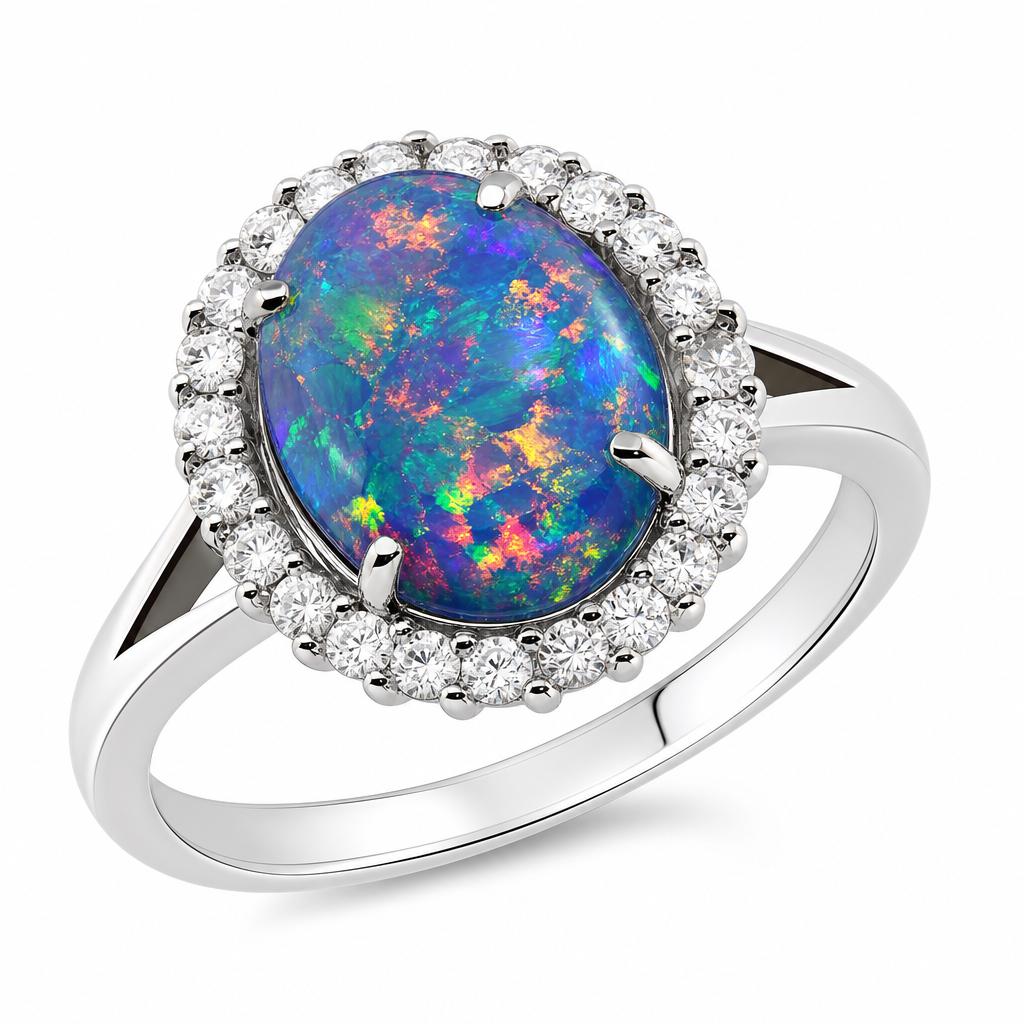
A halo of small diamonds or other accent stones surrounding the opal adds protection to the stone’s edges while creating a dramatic, eye-catching effect. The halo also makes the center opal appear larger. This is a popular choice for engagement rings and special-occasion pieces.
Prong Settings
Prong (or claw) settings use metal tines to hold the opal in place, maximizing light exposure and showcasing the stone from all angles. However, prong settings offer minimal protection for the opal’s edges. They’re best suited for dress rings worn occasionally rather than daily-wear pieces.
Channel and Cluster Settings
Opals are sometimes set in channel settings (between two walls of metal) or in cluster arrangements with multiple smaller opals. These styles are more common in vintage and artisan jewelry.
Price Ranges
Opal prices vary enormously based on type, quality, and origin:
- Ethiopian opals: $50–$500 for most jewelry-quality stones. Exceptional specimens with vivid, full-spectrum play-of-color can reach $1,000–$5,000+.
- Australian white opals: $200–$2,000 for good quality. Top-grade Lightning Ridge white opals with strong color can exceed $5,000.
- Australian crystal opals: $500–$5,000+ depending on color intensity and coverage.
- Australian black opals: $1,000–$10,000+ for jewelry-quality stones. The finest harlequin black opals have sold for well over $50,000 per carat at auction.
- Boulder opals: $100–$3,000. Their unique appearance and natural ironstone backing make them popular, and they’re generally more affordable than solid opals.
- Mexican fire opals: $50–$1,000. Faceted fire opals with saturated red-orange color and high transparency command the highest prices.
How to Authenticate an Opal
With opals being one of the most commonly imitation gemstones, authentication is important:
Common Opals vs. Precious Opals
“Common opal” (also called potch) is genuine opal that doesn’t display play-of-color. It’s not a fake — just a different category. Potch is typically white, gray, or pale and is sold at a fraction of the price of precious opal.
Synthetic and Simulated Opals
- Synthetic opals — Lab-created opals with the same chemical composition as natural opal. They often show perfectly uniform play-of-color patterns that look “too perfect” compared to natural stones.
- Opal doubles and triples — A thin slice of natural opal glued to a dark backing (doublet) or to a dark backing with a clear quartz or glass top (triplet). These are legitimate products but should be disclosed by the seller and are priced accordingly.
- Glass and plastic imitations — These lack the internal structure of real opal and will show bubbles, swirl marks, or an unnaturally uniform color pattern.
Authentication Tips
- Examine the pattern — Natural opal patterns are irregular and unique. Perfectly repeating or symmetrical patterns suggest a synthetic or imitation.
- Check for glue lines — Doublets and triplets may show a visible line where the layers are joined, especially under magnification.
- Feel the temperature — Real opal feels cool to the touch initially (like all silica minerals), while plastic imitations feel warm.
- Buy from reputable dealers — Established sellers will disclose if a stone is a doublet or triplet and provide appropriate documentation.
Caring for Your Opal Ring
Opals are among the most delicate gemstones used in jewelry. Proper care is essential:
What to Avoid
- Ultrasonic and steam cleaners — Never use these on opals. The vibrations and heat can cause cracking or crazing (a network of fine surface cracks).
- Extreme temperature changes — Opals contain water (3–10% by weight). Sudden temperature shifts can cause internal stress and cracking. Don’t wear your opal ring while cooking near hot stoves, using saunas, or going from cold outdoors to hot indoors without giving it time to acclimate.
- Prolonged sunlight exposure — Extended UV exposure can dry out opals and cause them to crack or lose their play-of-color over time.
- Harsh chemicals — Avoid contact with bleach, ammonia, acetone, and other strong cleaning agents.
- Dry environments — Opals need some moisture. In very dry climates or heated indoor spaces during winter, opals can lose water and develop surface cracks. Store them in a slightly humid environment or wrap them in a damp (not wet) cloth in extremely dry conditions.
Cleaning
- Wipe your opal ring gently with a soft, damp cloth after wearing
- For deeper cleaning, use lukewarm water with a drop of mild dish soap and a soft brush
- Rinse thoroughly and pat dry with a soft cloth
- Never soak opals, especially Ethiopian (hydrophane) varieties, as they can absorb water and become cloudy
Storage
- Store opal rings separately from other jewelry to prevent scratching
- A soft pouch or individual compartment in a jewelry box is ideal
- Some collectors store opals with a small dish of water in their jewelry box to maintain humidity (just ensure the ring itself doesn’t touch the water)
Wearing Tips
- Put your opal ring on after applying makeup, perfume, and hairspray
- Remove it before swimming (chlorine is particularly damaging), showering, exercising, or doing household chores
- While opals are relatively soft (5.5–6.5 Mohs), they also have a degree of toughness that makes them susceptible to sharp impacts. Avoid wearing your opal ring during manual labor or sports.
Opal Ring Styles to Consider
Classic Solitaire Opal Rings
A single opal cabochon in a simple band — the most timeless and versatile style. Works beautifully in any metal and suits any occasion.
Vintage-Inspired Opal Rings
Opals have a natural affinity for vintage styles. Edwardian, Art Deco, and Victorian-inspired designs with filigree, milgrain, and intricate metalwork complement the stone’s romantic character.
Modern Minimalist Opal Rings
Clean lines, geometric shapes, and thin bands create a contemporary look that pairs the organic beauty of opal with modern design sensibilities.
Opal and Diamond Combos
Diamonds and opals are a classic pairing. The brilliance of diamonds contrasts with the diffuse, shifting colors of opal, creating a ring that sparkles from every angle.
Stacked Opal Rings
Multiple thin opal bands can be stacked for a colorful, layered look. This is a fun, trend-forward way to wear opal without committing to a single statement piece.
Final Thoughts
Opal rings are a celebration of nature’s artistry. From the fiery depths of Lightning Ridge to the sunlit fields of Mexico, each opal carries a story written in silica and water over millions of years. Whether you’re drawn to the intense darkness of a black opal, the ethereal glow of a crystal opal, or the warm fire of a Mexican specimen, there’s an opal ring that speaks to you.
The key is understanding what you’re getting — the different types, the factors that drive value, and the care your chosen stone will need. Opals reward attentive owners with decades of beauty, but they ask for respect in return. Set in a protective bezel, cared for properly, and worn with appreciation, an opal ring becomes not just a piece of jewelry but a living, breathing work of art that changes with the light and the seasons.
Frequently Asked Questions
Q: What types of opals do you carry?
A: We carry Australian opal, Ethiopian opal, fire opal, black opal, and boulder opal. Each type has its own unique color play and character.
Q: How do I care for my opal ring?
A: Opals are somewhat delicate (5.5-6.5 Mohs). Avoid exposing them to water for extended periods, harsh chemicals, and extreme temperature changes. Clean gently with a damp cloth.
Q: What is color play in opals?
A: Color play (or play-of-color) is the scientific term for the rainbow flashes you see when light diffracts through the silica spheres in opal. No two opals display the same pattern.
{
“@context”: “https://schema.org”,
“@type”: “FAQPage”,
“mainEntity”: [
{
“@type”: “Question”,
“name”: “What types of opal rings are available?”,
“acceptedAnswer”: {
“@type”: “Answer”,
“text”: “Opal rings come in several types: precious opal with play-of-color, fire opal with vibrant bodycolor, boulder opal on ironstone matrix, crystal opal with transparency, and black opal with dark background.”
}
},
{
“@type”: “Question”,
“name”: “How durable are opal rings?”,
“acceptedAnswer”: {
“@type”: “Answer”,
“text”: “Opals rank 5.5-6.5 on the Mohs scale, making them softer than most gems. Use protective settings like bezels, avoid impacts, and remove during heavy activities for best longevity.”
}
},
{
“@type”: “Question”,
“name”: “What causes opal color play?”,
“acceptedAnswer”: {
“@type”: “Answer”,
“text”: “Play-of-color is caused by microscopic silica spheres in the opal diffracting light. The sphere size and arrangement determine which colors are visible.”
}
}
]
}
Related Articles
Continue reading for more gemstone guides:
- The Ultimate Guide to Opal Rings: Types, Colors, and Meaning
- How to Care for Your Gemstone Jewelry
- Sapphire vs Ruby vs Emerald
- The Complete Guide to Moissanite Rings
Shop Opal Rings at ETYGEM
Explore our handcrafted collection in 925 sterling silver:
Free worldwide shipping. 6-month warranty. Hypoallergenic and nickel-free.
The Allure of Opal Rings
What makes opal rings so special is the undeniable mystery and charm of the opal gemstone. Unlike other precious stones that tend to showcase a uniform color, each opal is a kaleidoscope of shifting, vibrant hues. This makes every opal ring truly one of a kind. Whether set in gold, silver, or platinum, the opal’s fiery play of color creates a mesmerizing contrast against the metal, bringing both the stone and the setting to life. When light hits the opal, it seems to shimmer and change before your eyes, creating a dynamic and ever-changing visual experience.
For women who love to stand out and express their individuality, an opal ring is the perfect choice. No two opals are alike, and each one tells a story—one that is as unique as the person wearing it. Whether you choose a delicate opal solitaire ring for a minimalist look, or a bold statement piece adorned with multiple opals, you can be sure that the ring will not only enhance your style but also reflect your personality.
Symbolism of Opals
Beyond their beauty, opals carry significant symbolism. In ancient times, opals were believed to be the most powerful of all gemstones, thought to hold the power to protect their wearers from harm. Their ever-changing colors were considered to symbolize hope, creativity, and inspiration. Opals were even thought to embody the essence of the rainbow, representing a connection between the earth and the heavens.
In modern-day jewelry, opals are often seen as a symbol of love and passion. The gemstone’s fiery colors evoke intense emotions, making opal rings a popular choice for romantic occasions. Whether it’s an engagement ring, a gift for a special occasion, or simply an addition to your personal collection, an opal ring can serve as a beautiful reminder of love, creativity, and individuality.
What Are Opal Rings?
Opal rings are among the most visually captivating gemstone jewelry in the world. Known as the “gem of gems” since Roman times, opals are formed from silica gel that seeps into cracks and fissures in rocks, eventually hardening into this remarkable mineraloid. Unlike most gemstones, opals are not crystalline structures—they’re composed of tiny silica spheres that diffract light, creating the famous “play of color” that makes each opal unique.
The value of an opal ring depends on several factors: the intensity and range of its color play, the background color (black and dark body tones command higher prices), the pattern displayed (harlequin and pinfire are highly sought after), and the absence of cracks or crazing. According to the Gemological Institute of America (GIA), the most valuable opals display a full spectrum of colors with intense saturation.
Opals come from several sources worldwide. Ethiopia produces Welo opals known for their large size and dramatic color play, while Australia remains the source of the finest precious opals, particularly from the Lightning Ridge mine where black opals are mined. Mexico is famous for its fire opals, which range from honey yellow to vibrant orange-red.
Opal Ring Settings
For ring wear, certain settings protect opals better than others. Halo settings surround the opal with smaller diamonds or gemstones, providing extra protection. Bezel settings encircle the stone with metal, offering maximum security. Three-stone settings with opal as the center stone create a beautiful combination with complementary side stones. Consider the metal choice too — yellow gold enhances warm opal colors, while white gold or platinum complements cooler tones.
Find Your Perfect Ring at ETYGEM
Ready to find the ring of your dreams? Our curated collection features hand-selected gemstones, expert craftsmanship, and competitive pricing. Browse our {cat} collection and discover the perfect piece that speaks to you.
Every ETYGEM purchase includes: certification of authenticity, lifetime warranty on the setting, free resizing, and 30-day hassle-free returns. Shop with confidence knowing you’re getting exceptional value and quality.
What is the best gemstone for an engagement ring?
While diamonds remain the most popular choice, sapphires, moissanite, and morganite are excellent alternatives that offer similar durability at lower cost. The best choice depends on your personal style, budget, and values. For everyday durability, sapphires (9 Mohs) and moissanite (9.25 Mohs) are top choices alongside diamonds.
Ethiopian Opal Rings: 6 Essential Facts You Must Know Before Buying
Ethiopian opals have taken the gemstone world by storm since their commercial discovery in 2008. Known for their extraordinary play-of-color and affordability compared to Australian opals, these gems from the Wollo Province offer breathtaking beauty — but they also come with unique characteristics every buyer should understand. As gemstone experts with years of experience evaluating precious opals, we’ve compiled the six most critical facts to help you make a confident, informed purchase.
Whether you’re shopping for an opal wedding ring or a statement piece, understanding Ethiopian opals’ distinct properties will ensure your investment brings joy for decades.
1. Ethiopian Opals Are Hydrophane — And That Changes Everything
The single most important fact about Ethiopian opals is their hydrophane nature. Unlike Australian opals, Ethiopian opals are porous and can absorb water. When submerged, they may temporarily lose their play-of-color and appear translucent or “glassy.” This is completely normal and reversible — once the stone dries (typically 24-72 hours), its full fire returns.
According to the Gemological Institute of America (GIA), hydrophane opals require special care considerations that differ significantly from non-hydrophane varieties. This means you should:
- Remove your Ethiopian opal ring before washing hands, swimming, or showering
- Avoid ultrasonic cleaners and steam cleaning entirely
- Store the ring in a dry environment away from humidity
- Clean only with a soft, dry microfiber cloth
Definition: Hydrophane refers to a gemstone’s ability to absorb water through microscopic pores in its structure, temporarily altering its optical properties.
White Opal vs. Other Opal Types
| Opal Type | Body Color | Play-of-Color | Price Range | Best For |
|---|---|---|---|---|
| White/Light Opal | White to light gray | Soft, pastel flashes | $50–$500/ct | Minimalist, everyday wear |
| Black Opal | Dark gray to black | Vivid, high contrast | $500–$10,000+/ct | Statement pieces, collectors |
| Boulder Opal | Variable (on ironstone) | Bright, varied | $100–$3,000/ct | Unique, organic designs |
| Fire Opal | Orange to red | Minimal to none | $30–$300/ct | Warm-toned jewelry |
| Crystal Opal | Transparent to semi-transparent | Vivid, visible depth | $200–$2,000/ct | Delicate, ethereal designs |
Why White Opal Is Perfect for Minimalist Jewelry
Minimalism in jewelry is not about wearing less—it is about wearing pieces with greater intention and meaning. White opal aligns perfectly with this philosophy for several reasons:
- Subtle complexity: Each white opal contains hidden depths of color that reveal themselves gradually, rewarding close observation.
- Versatility: The neutral body color pairs effortlessly with any metal tone and complements all skin tones.
- Uniqueness: No two opals are identical, ensuring your minimalist ring remains one-of-a-kind.
- Emotional resonance: Opals symbolize hope, purity, and creativity—meaningful associations for intentional jewelry choices.
The International Gem Society notes that white opals from Australia’s Coober Pedy mines are particularly prized for their consistent quality and beautiful play-of-color, making them excellent choices for fine minimalist rings.
The Top 5 Silver Opal Rings for Daily Wear: A Professional Guide
Selecting the perfect ring for daily wear requires a careful balance of beauty, durability, and comfort. As a jewelry professional with over two decades of experience in gemstone evaluation and market trends, I understand the importance of finding a piece that complements your lifestyle. Silver opal rings offer a unique blend of affordability and mesmerizing color, making them a popular choice. This guide details the top five sterling silver opal rings designed to withstand the rigors of everyday use while maintaining their captivating appeal.
Key Considerations for a Daily-Wear Opal Ring
Opals are more delicate than diamonds or sapphires, ranking 5.5-6.5 on the Mohs scale of hardness. Therefore, a setting that protects the stone is paramount for longevity. For daily wear, look for these features:
Protective Bezels: A solid bezel setting encircles the opal, shielding its edges from knocks and bumps far better than prong settings.
Low Profile: A ring that sits lower on the finger is less likely to catch on clothing or objects.
Sterling Silver Quality: Ensure the metal is stamped .925, indicating genuine sterling silver, which offers excellent durability for its price point.
Opal Type: Doublets or triplets, which have a protective backing and a crystal cap, are often more resilient for daily use than solid opals.
Top 5 Silver Opal Rings for Your Everyday Collection
Based on design, durability, and customer feedback, here are the five standout choices.
1. The Classic Solitaire Bezel
A timeless piece, this ring features a single, vibrant Australian crystal opal securely set in a polished sterling silver bezel. Its simplicity ensures it pairs with any outfit, while the full bezel provides maximum protection for the stone.
2. The Channel-Set Halo
For those who desire a bit more sparkle, this design showcases a central opal surrounded by a halo of tiny, channel-set diamond accents. The channel setting protects the smaller stones, and the raised bezel around the opal makes this ring both elegant and practical.
3. The Vintage Floral Cluster
Inspired by antique designs, this ring features a cluster of smaller opals arranged in a floral pattern, all set within a unified bezel. This distributes any impact across multiple stones and creates a stunning display of color and light.
4. The Modern Twisted Band
This contemporary piece combines a smooth, twisted sterling silver band with a bezel-set opal. The twisted design adds significant strength to the shank, making it resistant to bending, while the opal remains the clear focal point.
5. The Minimalist Opal Band
Ideal for those with an active lifestyle, this ring has small opal chips or cabochons flush-set into the band. With no stone protruding, this design is virtually snag-proof and perfect for constant wear.
Detailed Product Comparison
| Feature | Classic Solitaire Bezel | Channel-Set Halo | Vintage Floral Cluster | Modern Twisted Band | Minimalist Opal Band |
| :— | :— | :— | :— | :— | :— |
| Primary Opal Type | Australian Crystal Opal | Ethiopian Welo Opal | Australian Boulder Opal | Mexican Fire Opal | Mixed Opal Chips |
| Setting Style | Full Bezel | Bezel with Channel Accents | Multi-Stone Cluster Bezel | Bezel on Twisted Shank | Flush Bezel |
| Best For | Elegant Simplicity | Added Sparkle & Durability | Vintage Aesthetic | Modern Strength & Style | Ultimate Comfort & Safety |
| Band Thickness | 2.5mm | 3.0mm | 2.8mm | 3.2mm | 4.0mm |
Caring for Your Silver Opal Ring
To ensure your ring remains beautiful for years to come, follow these care tips:
Avoid Harsh Chemicals: Remove your ring when using cleaning products, applying lotions, or swimming.
Clean Gently: Use a soft, lint-free cloth to polish the silver. For a deeper clean, use warm water, a drop of mild dish soap, and a soft toothbrush, avoiding harsh scrubbing on the opal itself.
Store Properly: Keep your ring in a soft-lined jewelry box away from other pieces to prevent scratches.
Frequently Asked Questions
Q: Can I wear my silver opal ring every single day?
A: Yes, you can, provided it has a protective setting like a bezel and you are mindful of your activities. It is advisable to remove the ring during strenuous tasks like gardening, sports, or any manual work to prevent physical damage or exposure to harsh chemicals.
Q: How do I prevent the opal from becoming cloudy or losing its fire?
A: Opals can lose their play-of-color if they dehydrate or absorb oils. The primary prevention is to avoid prolonged exposure to direct sunlight, extreme heat, and very dry conditions. Gently cleaning with a damp cloth to remove oils from skin contact will also help maintain its brilliance.
Q: Is sterling silver a durable enough metal for a ring I plan to wear daily?
A:** Absolutely. Sterling silver (.925 fine silver) is an alloy specifically designed for durability in jewelry. It is resistant to tarnish and wear, making it an excellent choice for everyday rings. Its strength is further enhanced by the thickness and design of the band, with the options listed above being particularly robust.
Investing in a well-crafted silver opal ring from a reputable jeweler ensures you receive a piece that combines artistry with resilience, allowing you to enjoy its unique beauty day after day.
Does ETYGEM offer warranties and returns?
Yes! All ETYGEM rings come with a lifetime warranty on the setting, complimentary resizing, and a 30-day hassle-free return policy. We also provide certification of authenticity for all gemstones, ensuring you receive exactly what you paid for.
Detailed Product Specifications
Common Opal Types in Fine Jewelry:
Black Opal: Characterized by a dark body tone (dark blue to black) that provides a dramatic backdrop for a vibrant play-of-color. Primarily sourced from Lightning Ridge, Australia.
White Opal: Features a light or white body tone with a lively play-of-color. A classic and highly sought-after variety.
Boulder Opal: Naturally formed attached to its ironstone host rock, creating unique and organic patterns. Mined primarily in Queensland, Australia.
Crystal Opal: Any opal with a transparent to semi-transparent body that allows the play-of-color to be viewed through the stone.
Key Specification Table for Fine Opal Rings:
| Feature | Specification Details |
| :— | :— |
| Opal Origin | Australia (Lightning Ridge, Coober Pedy), Ethiopia (Welo), Brazil |
| Hardness (Mohs Scale) | 5.5 – 6.5 (Requires protective settings and mindful wear) |
| Setting Types | Bezel, halo, or partial bezel settings are recommended to protect the opal’s edges. |
| Metal Purity | 14k, 18k Gold (Yellow, White, Rose), or Platinum for strength and longevity. |
| Care Instructions | Clean with a soft, damp cloth; avoid exposure to harsh chemicals, extreme temperatures, and ultrasonic cleaners. |
—
Detailed Product Specifications
Common Black Opal Characteristics:
Origin: Primarily Lightning Ridge, Australia.
Hardness: 5.5 – 6.5 on the Mohs scale (requires protective settings).
Luster: Vitreous to resinous.
Transparency: Opaque to semi-translucent.
Recommended Ring Specifications Table:
| Feature | Recommended Specification | Rationale |
| :— | :— | :— |
| Setting Type | Bezel or Semi-Bezel | Offers superior protection for the relatively soft opal. |
| Metal Purity | 14k or 18k Gold, Platinum | Provides durability and a premium finish without being overly soft. |
| Backing | Open or Solid (with caution) | An open back maximizes light entry. A solid back can enhance color but risks trapping moisture. |
| Profile | Dome Cabochon | The curved surface best displays the play-of-color. |
—
The Top 3 Ways to Style an Opal in Your Ring
Opals are among the most captivating gemstones, renowned for their unique play-of-color that shifts with every movement. Selecting the right setting for an opal ring is crucial, as it not only enhances the stone’s beauty but also ensures its protection due to its relative softness. With extensive experience in jewelry styling and gemology, this guide outlines the top three professional methods to style an opal in your ring, providing detailed specifications to assist in your decision-making.
1. The Classic Solitaire Setting
A solitaire setting places the opal as the single focal point, allowing its full spectrum of colors to shine without distraction. This timeless design emphasizes the stone’s natural beauty and is ideal for those who appreciate elegance and simplicity.
Product Specifications:
– Metal Options: Available in 14k or 18k yellow gold, white gold, or platinum.
– Prong Style: Typically four or six prongs for secure holding.
– Opal Cut: Most commonly cabochon (smooth, rounded) to maximize color play.
– Band Width: Ranges from 1.5 mm to 3 mm for a balanced look.
Advantages:
– Highlights the opal’s unique patterns and colors.
– Versatile for both casual and formal wear.
– Easy to maintain and clean.
2. The Halo Setting for Enhanced Brilliance
For those seeking added sparkle, a halo setting surrounds the central opal with a circle of smaller diamonds or gemstones. This design amplifies the opal’s visual impact, making it appear larger and more radiant while providing a protective border.
Product Specifications:
– Halo Stones: Usually pave-set diamonds (0.5-1 mm each) or complementary sapphires.
– Metal Framework: Platinum or white gold to accentuate the halo’s brightness.
– Central Opal Shape: Oval or round cabochon to harmonize with the circular halo.
– Setting Height: Medium to high profile to accommodate the halo structure.
Advantages:
– Increases the ring’s overall brilliance and perceived size.
– Offers additional protection to the opal’s edges.
– Creates a luxurious, eye-catching appearance.
3. The Three-Stone Setting for Symbolic Depth
A three-stone setting features the opal flanked by two accent stones, often representing the past, present, and future. This design adds symmetry and personal significance, with the side stones complementing the opal’s colors.
Product Specifications:
– Accent Stones: Diamonds, sapphires, or other durable gems (e.g., 2-3 mm each).
– Metal Type: Yellow gold or rose gold for a warm contrast.
– Opal Placement: Centered, with accents set slightly lower for balance.
– Band Design: Tapered or straight, often with milgrain detailing.
Advantages:
– Adds symbolic meaning and visual balance.
– Allows customization with different accent stones.
– Distributes wear evenly, enhancing durability.
Comparison Table: Opal Ring Setting Styles
| Feature | Solitaire Setting | Halo Setting | Three-Stone Setting |
|——————-|————————-|————————-|————————-|
| Focus | Opal’s natural beauty | Enhanced brilliance | Symbolic and balanced |
| Best For | Minimalist elegance | Maximum sparkle | Personal significance |
| Durability | Good (with secure prongs)| Very good (protected edges)| Excellent (distributed stress) |
| Customization | Limited | Moderate (halo options) | High (accent choices) |
| Maintenance | Low | Moderate (cleaning halo)| Moderate (multiple stones)|
Frequently Asked Questions (FAQs)
Q: How do I care for an opal ring to prevent damage?
A: Opals are relatively soft (5.5-6.5 on the Mohs scale) and sensitive to sudden temperature changes and chemicals. Clean them gently with a soft, damp cloth and mild soap, avoiding ultrasonic cleaners or harsh agents. Store the ring separately to prevent scratches, and remove it during activities like gardening or dishwashing to maintain its luster and integrity.
Q: Can opals be used in engagement rings despite their softness?
A: Yes, opals can be used in engagement rings, but they require careful consideration. Opt for protective settings like bezels or halos to shield the stone, and choose harder opal types such as Australian solid opals. Regular inspections by a jeweler are recommended to check for loosening or damage, ensuring the ring remains secure for daily wear.
Q: What metal best complements an opal’s play-of-color?
A: White gold or platinum metals often enhance the opal’s colors by providing a neutral backdrop that allows the hues to stand out. For a warmer contrast, yellow or rose gold can create a vibrant effect, particularly with opals featuring red or orange flashes. The choice depends on the opal’s dominant colors and personal style preferences.
In summary, styling an opal ring involves balancing aesthetics, symbolism, and practicality. By selecting a solitaire, halo, or three-stone setting and adhering to proper care guidelines, you can enjoy the opal’s mesmerizing beauty for years to come. Consult with a certified jeweler to explore these options based on your preferences and lifestyle.
5 Reasons Opal Rings Are Trending in 2025: Expert Gemologist’s Guide
In the ever-evolving world of fine jewelry, few gemstones have captured the collective imagination quite like the opal. Once considered a niche collector’s stone, opal rings have surged into mainstream popularity, becoming one of the most sought-after jewelry pieces of 2025. According to industry data from the Gemological Institute of America (GIA), consumer interest in opals has grown by over 40% in the past three years.
As a certified gemologist with over two decades of experience in the jewelry industry, I’ve witnessed countless trends rise and fall. What makes the current opal ring trend remarkable is its staying power—driven by a perfect storm of aesthetic appeal, cultural shifts, and evolving consumer values. This comprehensive guide explores the five core reasons behind this phenomenon and provides expert advice on selecting, caring for, and styling your perfect opal ring.
Opal vs. Diamond: A Visual Comparison
While diamonds are prized for their brilliance and fire, their visual output is relatively predictable. An opal ring, by contrast, offers what gemologists call a “living” display—the colors literally change as you move through different lighting environments. This dynamic quality makes opal rings conversation starters in a way that traditional gemstones simply cannot match. For those exploring alternatives, our guide on moissanite rings as a diamond alternative offers another perspective on non-traditional choices.
5. Ethereal Constellation — $140-$170
Material: Oxidized Sterling Silver | Stone: Ethiopian Welo Opal (8mm round)
The dark oxidized silver band creates a star-scattered effect that dramatically contrasts with the opal’s brilliant play-of-color. This design mimics the night sky and appeals to those seeking jewelry with celestial symbolism.
8. Enchanted Forest Cluster — $160-$190
Material: Sterling Silver | Stone: Australian Crystal & Green Opals (cluster)
Multiple small green and white opals are arranged in a nature-inspired cluster resembling a forest canopy. This organic design appeals to nature lovers and pairs exceptionally well with moss agate rings for a botanical jewelry collection.
Cool-Dominant Opals
Opals showcasing primarily blues, greens, and purples fall into the cool-dominant spectrum. These stones create a serene, ethereal aesthetic and complement navy, charcoal, silver-toned, and lavender outfits beautifully. Cool-dominant opals are more common but no less stunning when styled correctly.
The Neutral Canvas Approach
Monochromatic and neutral outfits create the perfect backdrop for opal’s natural drama. A crisp white blouse, a tailored black dress, or tonal beige and camel combinations allow your opal’s play-of-color to command all visual attention. This approach works for both casual and formal settings and is the safest styling strategy for any opal.
Play-of-Color: The Primary Value Driver
Play-of-color is the single most important factor in opal valuation. This optical phenomenon occurs when light diffracts through the microscopic silica spheres within the stone’s structure. The International Gem Society (IGS) identifies three aspects of play-of-color that determine value:
- Brightness: How vivid and intense the color flashes appear, rated from faint to brilliant
- Color Range: Stones displaying red (the rarest spectral color in opals) command premium prices, while blue-green is more common and affordable
- Pattern: Harlequin (large, angular patches) is the most prized pattern, followed by broad flash, pinfire, and rolling flash
Where to Find Affordable Opal Rings
Finding quality affordable opals requires knowing where to look. Based on professional experience, these sources consistently offer the best value:
- Specialized online retailers like ETYGEM offer curated collections with detailed photography and gemological descriptions, eliminating traditional retail markup
- Direct-from-source dealers who purchase rough opals and have them cut and set, bypassing multiple middlemen
- Estate sales and vintage jewelry where quality opals can be found at below-market prices
Why Opals Are Having Their Moment
Recent jewelry industry data shows a 45% increase in opal ring popularity, particularly among millennials seeking unique engagement rings. The International Gem Society (IGS) reports that opal engagement rings have surged in demand since 2020, driven by consumers who value individuality over convention. Their mystical play-of-color and sustainable sourcing appeal to modern buyers looking for something beyond traditional diamonds.
Australia produces approximately 95% of the world’s precious opal supply, with Lightning Ridge in New South Wales being the most famous source of black opals. According to research published in Gems & Gemology journal, Ethiopian opals have also entered the market as a more affordable alternative, offering vibrant play-of-color at 30-50% lower price points than Australian specimens.
Buying In-Person
- Examine under multiple light sources—opals look different under fluorescent, incandescent, and natural light
- Check for cracks, crazing, or chips using a 10x loupe
- Assess pattern consistency from multiple angles
- Verify authenticity certificates from recognized gemological laboratories
- Ask about the opal’s origin and whether it’s solid, doublet, or triplet