Moss Agate Rings: Nature’s Masterpiece in Gemstone Jewelry
In the world of gemstones and jewelry, few stones evoke the sense of wonder and natural artistry quite like moss agate. With its intricate, moss-like inclusions that seem to dance within translucent green and white hues, moss this gem rings stand out as truly mesmerizing pieces of wearable art. According to the International Gem Society (IGS), this chalcedony is a form of chalcedony (a microcrystalline variety of quartz) that contains mineral inclusions resembling moss, ferns, or trees—creating miniature landscapes frozen in stone millions of years ago.
The Gemological Institute of America (GIA) classifies moss agate as a semi-translucent to opaque variety of chalcedony with dendritic (tree-like) inclusions of iron or manganese oxides. Despite its name, this green gem contains no organic matter—the “moss” patterns are entirely mineral formations that developed as metallic solutions permeated through silica-rich rock over geological timescales.
The Geological Origins of Moss Agate
Moss agate forms in volcanic rock cavities where silica-rich groundwater deposits layers of chalcedony over millions of years. The IGS explains that the distinctive green, brown, and black inclusions develop when iron and manganese oxides infiltrate the forming this chalcedony through microscopic fractures. The resulting patterns are completely random and unrepeatable—meaning every the stone ring is genuinely one-of-a-kind.
Major sources of gem-quality moss agate include:
- India: The world’s largest producer, particularly from the Deccan Plateau region. Indian moss agate is known for vivid green inclusions against clear to milky white backgrounds.
- Brazil: Produces specimens with exceptional translucency and fine, delicate moss patterns
- Uruguay: Known for deeper green coloration and denser inclusion patterns
- United States: Montana, Oregon, and Wyoming produce distinctive varieties with unique color combinations
- Indonesia: Emerging source of high-quality material with dramatic contrast patterns
Gemological Properties of Moss Agate
Understanding moss agate’s physical properties helps explain its suitability for ring jewelry:
- Mohs Hardness: 6.5-7, placing it in the “good durability” range for daily-wear rings according to GIA standards
- Refractive Index: 1.530-1.540
- Specific Gravity: 2.58-2.64
- Crystal System: Hexagonal (microcrystalline)
- Fracture: Conchoidal to uneven
- Luster: Waxy to vitreous when polished
- Transparency: Semi-translucent to opaque
Research published in Gems & Gemology journal confirms that moss agate’s hardness of 6.5-7 makes it comparable to jade and tanzanite in durability—suitable for engagement rings and daily wear when set in protective mountings.
Why Moss Agate Rings Are Perfect for Engagement Rings
The surge in moss agate engagement ring popularity reflects broader shifts in consumer preferences. The IGS reports that searches for “this natural mineral proposal ring” have increased over 300% since 2020. Several factors drive this trend:
Uniqueness
No two moss agate stones are identical. The random nature of mineral inclusion formation means your ring will be completely unique—a powerful symbol for a one-of-a-kind relationship. Unlike diamonds graded on standardized scales, each this chalcedony tells its own geological story.
Affordability
High-quality moss agate ranges from $5-$50 per carat, compared to $2,000-$20,000+ for diamonds. This means couples can invest in superior craftsmanship and precious metal settings while keeping total ring costs between $200-$800—a fraction of the average $6,000 diamond engagement ring.
Symbolism
Moss agate has been associated with growth, new beginnings, and abundance across cultures for millennia. Ancient Greeks and Romans used it as a talisman for agricultural prosperity. For modern couples, it symbolizes a relationship that grows and flourishes naturally—making it deeply meaningful as an engagement stone.
Sustainability
Moss agate mining has minimal environmental impact compared to diamond extraction. The stone is abundant, requires no deep-earth mining operations, and is often sourced from small-scale, artisanal miners. For eco-conscious couples, this represents a meaningful alignment of values with aesthetics.
Moss Agate Ring Styles and Settings
Solitaire Settings
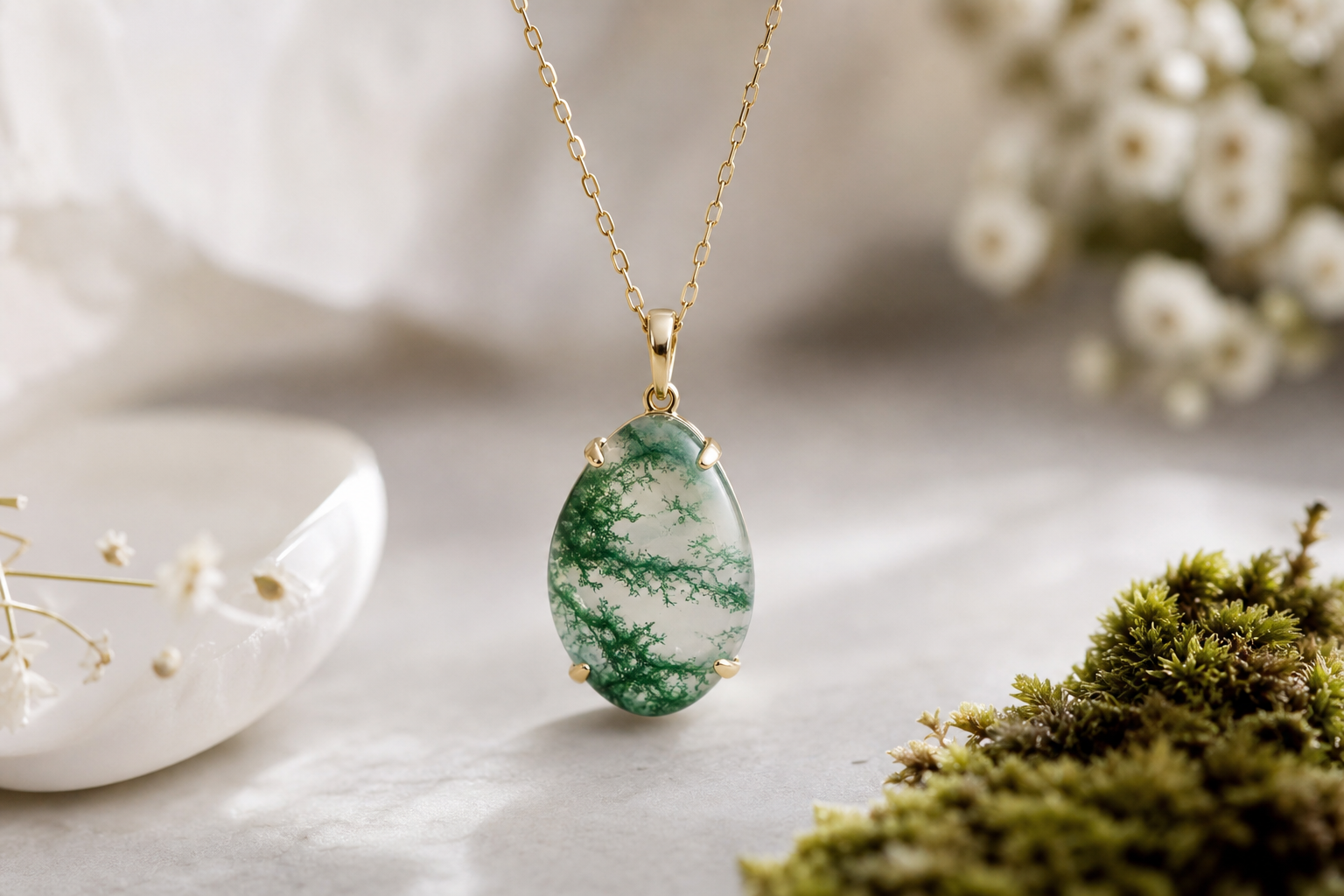
Minimalist settings that showcase the stone’s natural patterns are the most popular choice. A single oval or pear-shaped moss agate in a simple gold bezel or prong setting allows the internal “landscape” to become the focal point. The IGS recommends bezel settings for this green gem to protect the stone’s edges during daily wear.
Vintage and Art Deco Designs
Intricate metalwork with milgrain details, filigree patterns, and oxidized finishes complement moss agate’s organic beauty. These designs often incorporate small accent diamonds or white sapphires that frame the center stone without competing with its natural artistry.
Nature-Inspired Settings
Leaf-wrapped bands, twig-textured settings, and vine motifs echo the botanical patterns within the stone itself. Rose gold is particularly popular for nature-inspired moss agate rings, as its warm pink tone complements the green inclusions beautifully.
Kite and Hexagonal Cuts
Non-traditional geometric cuts have become signature shapes for moss agate engagement rings. Kite (elongated diamond shape) and hexagonal cuts maximize the visible inclusion area while creating a modern, distinctive silhouette on the finger.
Choosing the Perfect Moss Agate Stone
The GIA doesn’t formally grade moss agate like diamonds, but experienced gemologists evaluate quality based on:
Inclusion Pattern
The most valued specimens display well-distributed, clearly defined moss patterns against a clean, translucent background. Look for stones where the inclusions create recognizable natural scenes—forests, ferns, or abstract landscapes. Avoid stones where inclusions are muddy, overly dense, or concentrated in one area.
Translucency
Higher translucency allows more light to interact with the inclusions, creating depth and dimension. The best moss agates appear to have three-dimensional “scenes” suspended within the stone. Hold the stone up to light—you should see some light passing through the clearer areas.
Color Contrast
Strong contrast between the green/brown inclusions and the clear/white background creates the most visually striking rings. Stones with vivid green moss against crystal-clear chalcedony command the highest prices and visual appeal.
Surface Quality
Examine for surface-reaching fractures, pits, or rough spots that could affect durability. Well-polished specimens should have a smooth, waxy-to-vitreous luster across the entire cabochon or faceted surface.
Metal Pairing Recommendations
The metal choice dramatically affects how a moss agate ring presents:
- 14K/18K Yellow Gold: Creates a warm, earthy aesthetic that complements the green tones. Classic and timeless.
- 14K/18K Rose Gold: The most popular pairing—pink gold creates beautiful contrast with green inclusions and adds romantic warmth.
- 14K/18K White Gold: Clean, modern look that lets the stone’s colors stand out against a neutral background.
- Platinum: Maximum durability and hypoallergenic properties. Best for active lifestyles.
- Sterling Silver: Budget-friendly option suitable for fashion rings or occasional wear pieces.
Care and Maintenance for Moss Agate Rings
The IGS provides these care guidelines for maintaining your moss agate ring’s beauty:
- Cleaning: Warm soapy water with a soft brush is ideal. Avoid ultrasonic and steam cleaners, which can damage inclusions or cause thermal shock.
- Storage: Store separately from harder gemstones (diamonds, sapphires, rubies) that could scratch the surface. Use individual soft pouches.
- Chemical exposure: Remove before using household cleaners, chlorine pools, or applying lotions and perfumes directly to the ring.
- Impact protection: While reasonably durable at Mohs 6.5-7, moss agate can chip if struck sharply. Remove during sports, gardening, and heavy manual work.
- Professional check-ups: Have settings inspected annually to ensure prongs or bezels remain secure.
Moss Agate in History and Culture
The cultural significance of moss agate spans thousands of years. Ancient civilizations across India, Greece, and Egypt appreciated the stone not just for its aesthetic appeal but also for its perceived metaphysical properties. According to historical records cited by the IGS:
- Ancient Rome: Moss agate was carved into talismans believed to ensure bountiful harvests and protect travelers
- Medieval Europe: Warriors wore moss agate amulets for strength and victory in battle
- Indigenous Australian cultures: Used as a rain-bringing stone in ceremonial practices
- 18th-19th Century Britain: Moss agate was extremely fashionable in Victorian jewelry, particularly in Scottish designs
Today, moss agate remains associated with emotional balance, patience, and harmony—qualities that make moss the stone rings a meaningful addition to any jewelry collection, whether as an engagement ring, anniversary gift, or personal talisman.
Price Guide: What to Expect
Moss agate rings offer exceptional value across all budget levels:
- Sterling silver fashion rings: $30-$100
- 14K gold solitaire (simple setting): $200-$450
- 14K gold with accent stones: $400-$700
- Custom designer pieces: $600-$1,200
- Platinum with diamond accents: $800-$1,500
The stone itself typically represents only 5-15% of the total ring cost, with the majority going toward metalwork and craftsmanship—meaning you’re investing in quality construction rather than inflated gem prices.
Ready to find your perfect piece? Browse our handcrafted collection and discover gemstone jewelry that tells your unique story.
Frequently Asked Questions
Is moss agate durable enough for an engagement ring worn daily?
Yes. At 6.5-7 on the Mohs hardness scale, moss agate is comparable to jade and tanzanite in durability. The GIA considers this hardness range suitable for rings worn daily, provided you choose a protective setting (bezel or low-profile halo) and remove the ring during high-impact activities. Many this natural mineral engagement rings remain beautiful after 10-20+ years of regular wear.
How do I know if my moss agate is real or dyed?
Natural moss agate has inclusions that appear three-dimensional and are distributed irregularly throughout the stone. Dyed or enhanced specimens often show color concentrated along surface fractures or an unnaturally uniform green tint. The IGS recommends purchasing from reputable sellers who disclose any treatments. Under magnification, natural inclusions appear as distinct mineral formations rather than diffused color.
Can moss agate rings get wet?
Brief water exposure (hand washing) is fine. However, prolonged soaking, chlorinated pools, hot tubs, and saltwater should be avoided. The GIA notes that while chalcedony is relatively stable, repeated chemical exposure can dull the polish over time. Remove your ring before swimming, bathing, or doing dishes for best long-term preservation.
What finger should a moss agate ring be worn on?
As an engagement ring, it’s traditionally worn on the left ring finger. However, moss agate’s association with growth and abundance makes it popular on any finger. Crystal practitioners often recommend the middle finger (associated with balance) or index finger (associated with ambition). Ultimately, wear it wherever feels most comfortable and meaningful to you.
Does moss agate change color over time?
Natural moss agate is color-stable and will not fade or change color under normal wearing conditions. The mineral inclusions (iron and manganese oxides) are chemically stable. However, prolonged direct sunlight exposure over years could theoretically affect some specimens. The IGS recommends storing this chalcedony away from direct sunlight when not being worn, though this is a precautionary measure rather than a common concern.