

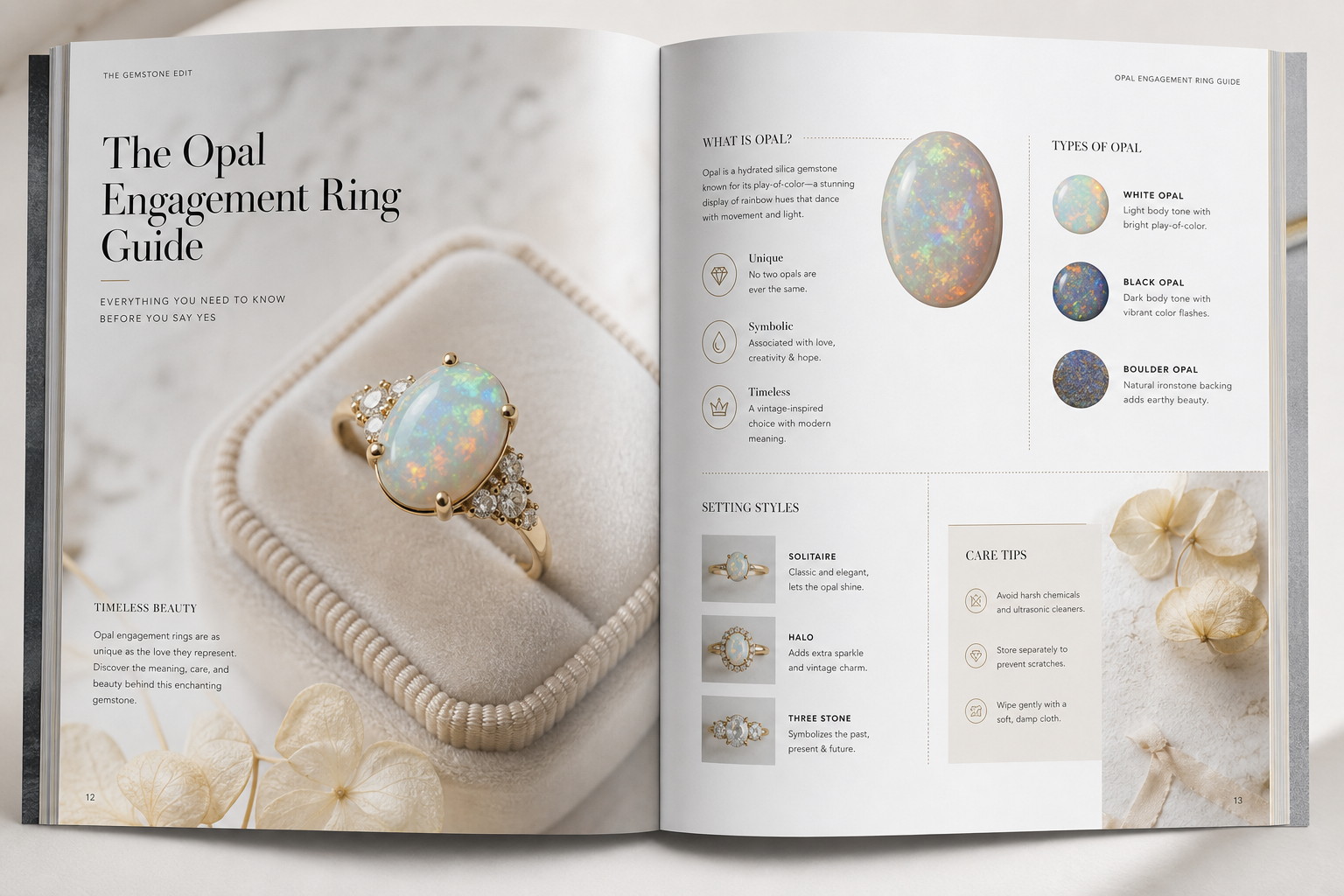
Opal engagement rings have surged in popularity over the past few years. More couples are stepping away from traditional diamonds and choosing stones that feel personal, artistic, and full of character. Opals deliver all of that — with their shifting play of color, no two stones look alike.
But is an opal the right choice for a ring you’ll wear every day for decades? This guide breaks down the real pros and cons of opal engagement rings, compares opals to other popular gemstones, and gives you practical advice on choosing and caring for one.
Pros of Opal Engagement Rings
1. Unmatched Visual Uniqueness
Opals display a phenomenon called “play of color” — flashes of spectral color that shift as the stone moves. This means every single opal is one-of-a-kind. Unlike diamonds, which are graded on standardized scales, opals offer a truly individual look. If your partner values originality over convention, an opal says something that a round brilliant diamond simply cannot.
2. Significantly More Affordable
High-quality opals typically range from $50 to $500 per carat for solid stones, with exceptional Australian black opals reaching $2,000–$10,000 per carat. Compare that to diamonds, where a decent 1-carat stone starts around $4,000–$8,000. For the same budget, you can get a larger, more visually striking opal — or save money for the wedding itself.
3. Rich Symbolism and History
Throughout history, opals have symbolized hope, creativity, and passion. The ancient Romans called opal “opalus” — meaning precious stone — and considered it the most powerful gem because it contained the colors of all other stones. In modern contexts, opals represent emotional depth and artistic spirit, making them meaningful for couples who connect on a creative level.
4. Versatile Color Options
Opals come in a wide spectrum: white opals with pastel flashes, black opals with vivid electric colors, boulder opals with natural ironstone backing, fire opals in warm orange and red tones, and crystal opals with transparent bodies. This variety means you can match the stone to your partner’s personal style — cool blues and greens, warm reds and oranges, or a full rainbow.
5. Ethical and Sustainable Sourcing
Most gem-quality opals come from Australia (about 95% of the world’s supply), with additional sources in Ethiopia, Mexico, and Brazil. Opal mining is generally small-scale compared to diamond mining, with less environmental disruption and fewer ethical concerns around labor practices. For couples who care about sourcing, opals offer a cleaner conscience.
6. Pairs Beautifully with Alternative Metals
Opals look stunning in rose gold, yellow gold, and even mixed-metal settings. Their color play picks up warm tones from gold in ways that diamonds don’t. This opens up more creative ring design possibilities — vintage-inspired halos, nature-themed settings, or minimalist bezels that let the stone speak for itself.
Cons of Opal Engagement Rings
1. Lower Hardness Means Higher Risk of Damage
This is the biggest concern. Opals rate 5.5 to 6.5 on the Mohs hardness scale, compared to diamond’s 10 and sapphire’s 9. In practical terms, opals can be scratched by everyday materials like dust (which contains quartz at Mohs 7). Over years of daily wear, an unprotected opal will show surface wear. This doesn’t mean opals are fragile glass — but they do require more careful handling than harder stones.
2. Sensitivity to Water and Chemicals
Opals contain 3–21% water within their silica structure. Prolonged exposure to water (especially hot water), harsh chemicals, or rapid temperature changes can cause “crazing” — fine cracks across the surface. You’ll need to remove an opal ring before washing dishes, swimming, showering, or using cleaning products. Ethiopian opals (hydrophane type) are particularly absorbent and can temporarily lose their play of color when wet.
3. Not Ideal for Very Active Lifestyles
If your partner works with their hands — gardening, rock climbing, weightlifting, construction — an opal engagement ring faces higher risk of impact damage. While protective settings help (more on that below), the stone itself is more vulnerable than sapphire or moissanite. Some couples solve this by having a secondary “activity ring” and saving the opal for everyday non-physical wear.
4. Requires Regular Maintenance
To keep an opal looking its best, you’ll want to clean it gently with a soft damp cloth (no ultrasonic cleaners, no steam), store it away from heat sources, and have the setting checked annually by a jeweler. It’s not high-maintenance in the way that, say, a vintage car is — but it does ask for more attention than a diamond ring you can essentially ignore.
5. Superstition Factor (Minor but Real)
Some people still hold the old superstition that opals are “bad luck” — a myth largely traced to a 19th-century novel by Sir Walter Scott. While most modern buyers don’t take this seriously, it’s worth knowing that a few family members might raise an eyebrow. If your partner’s family is traditional, this could come up.
Opal vs Other Gemstones: Quick Comparison
| Feature | Opal | Diamond | Sapphire | Moissanite |
|---|---|---|---|---|
| Hardness (Mohs) | 5.5–6.5 | 10 | 9 | 9.25 |
| Price per Carat | $50–$10,000 | $4,000–$20,000+ | $500–$5,000 | $300–$600 |
| Uniqueness | Every stone different | Standardized grading | Color varies | Consistent |
| Daily Wear Durability | Moderate (needs care) | Excellent | Excellent | Excellent |
| Color Options | Full spectrum + play of color | Mostly colorless | Blue, pink, yellow, etc. | Colorless or tinted |
| Ethical Concerns | Low | Variable | Variable | Lab-created (none) |
How to Choose the Right Opal Engagement Ring
Pick a Protective Setting
The setting matters more for opals than for harder stones. Your best options:
- Bezel setting — A metal rim wraps completely around the stone’s edge, protecting it from side impacts. This is the gold standard for opal protection.
- Halo setting — Surrounding smaller stones (diamonds or sapphires) act as a buffer, keeping the opal slightly recessed.
- Low-profile design — A stone that sits close to the finger is less likely to catch on things or take direct hits.
Avoid tall prong settings that leave the opal exposed on all sides — these work for diamonds but put opals at unnecessary risk.
Choose the Right Opal Type
- Australian solid opals — Most durable, best play of color, highest value. Black opals from Lightning Ridge are the premium choice.
- Boulder opals — Natural ironstone backing adds strength. Good balance of durability and visual impact.
- Crystal opals — Transparent body shows color beautifully but is slightly more delicate.
- Ethiopian opals — Stunning colors at lower prices, but hydrophane nature makes them more water-sensitive.
- Doublets and triplets — Layered opals with protective backing/cap. More affordable and more durable, but not solid opal throughout.
Consider the Band Metal
Platinum and 14k/18k gold are both excellent choices. Avoid sterling silver for daily-wear rings — it’s too soft and tarnishes. Rose gold pairs particularly well with opals that show warm color play, while white gold or platinum complements cool blue-green flashes.
Get the Right Size — First Time
Resizing a ring with an opal is riskier than resizing a diamond ring because the heat and pressure involved can damage the stone. Get an accurate ring size before ordering, or choose a setting style that allows for minor adjustments without stressing the stone.
Caring for Your Opal Engagement Ring
Daily care doesn’t need to be complicated, but consistency matters:
- Remove before water activities — Dishes, swimming, showering, hand-washing. Make it a habit.
- Store separately — Keep your opal ring in a soft pouch or lined box, away from harder jewelry that could scratch it.
- Clean gently — Soft cloth, slightly damp with room-temperature water. Never use ultrasonic cleaners, steam, or chemical solutions.
- Avoid temperature shocks — Don’t go from a hot car to an air-conditioned room with the ring on. Rapid temperature changes stress the stone’s internal water content.
- Annual jeweler check — Have a professional inspect the setting once a year to make sure prongs or bezels haven’t loosened.
- Keep away from cosmetics — Put your ring on last, after applying lotion, perfume, and sunscreen.
With proper care, a well-set opal can last generations. Many antique opal rings from the Victorian era are still in beautiful condition today — proof that these stones can endure when treated with respect.
Frequently Asked Questions
Is opal too soft for an engagement ring?
Not necessarily. At 5.5–6.5 on the Mohs scale, opal is softer than sapphire or diamond, but it’s harder than pearl (which people wear daily without issue). The key is choosing a protective setting like a bezel and being mindful about when you wear it. Thousands of people wear opal engagement rings successfully — it just requires a bit more awareness than a diamond.
How long will an opal engagement ring last?
With proper care and a good setting, an opal engagement ring can last a lifetime and beyond. Victorian-era opal rings (150+ years old) are still worn today. The stone may develop a soft patina over decades, which many owners find adds character. If the surface does get scratched, opals can be professionally re-polished.
Can you get opal engagement rings wet?
Brief, accidental water contact is fine — washing your hands quickly won’t destroy the stone. But prolonged soaking, hot water, chlorinated pools, and chemical exposure should be avoided. The safest habit is to remove the ring before any water-intensive activity. Ethiopian hydrophane opals are more water-sensitive than Australian opals.
What’s the best opal type for an engagement ring?
Australian solid opals (especially black opals or boulder opals) offer the best combination of durability and visual impact for daily wear. They’re denser and less porous than Ethiopian opals. If budget is a concern, a quality opal doublet with a protective cap gives you great color play with added durability at a lower price point.
Final Thoughts
An opal engagement ring isn’t for everyone — and that’s exactly the point. It’s for the couple who values individuality over convention, who appreciates that beautiful things sometimes need a little extra care, and who wants a ring that tells a story every time light hits it differently.
The pros are compelling: unmatched beauty, meaningful symbolism, better value, and ethical sourcing. The cons are real but manageable: lower hardness, water sensitivity, and the need for mindful daily habits. If you and your partner are willing to treat the ring with a bit of intention, an opal can be a stunning, lasting symbol of your relationship.
Ready to explore opal engagement rings? Browse our opal ring collection for handcrafted designs, or check out our full gemstone ring selection and engagement ring gallery to find the perfect match for your love story.