

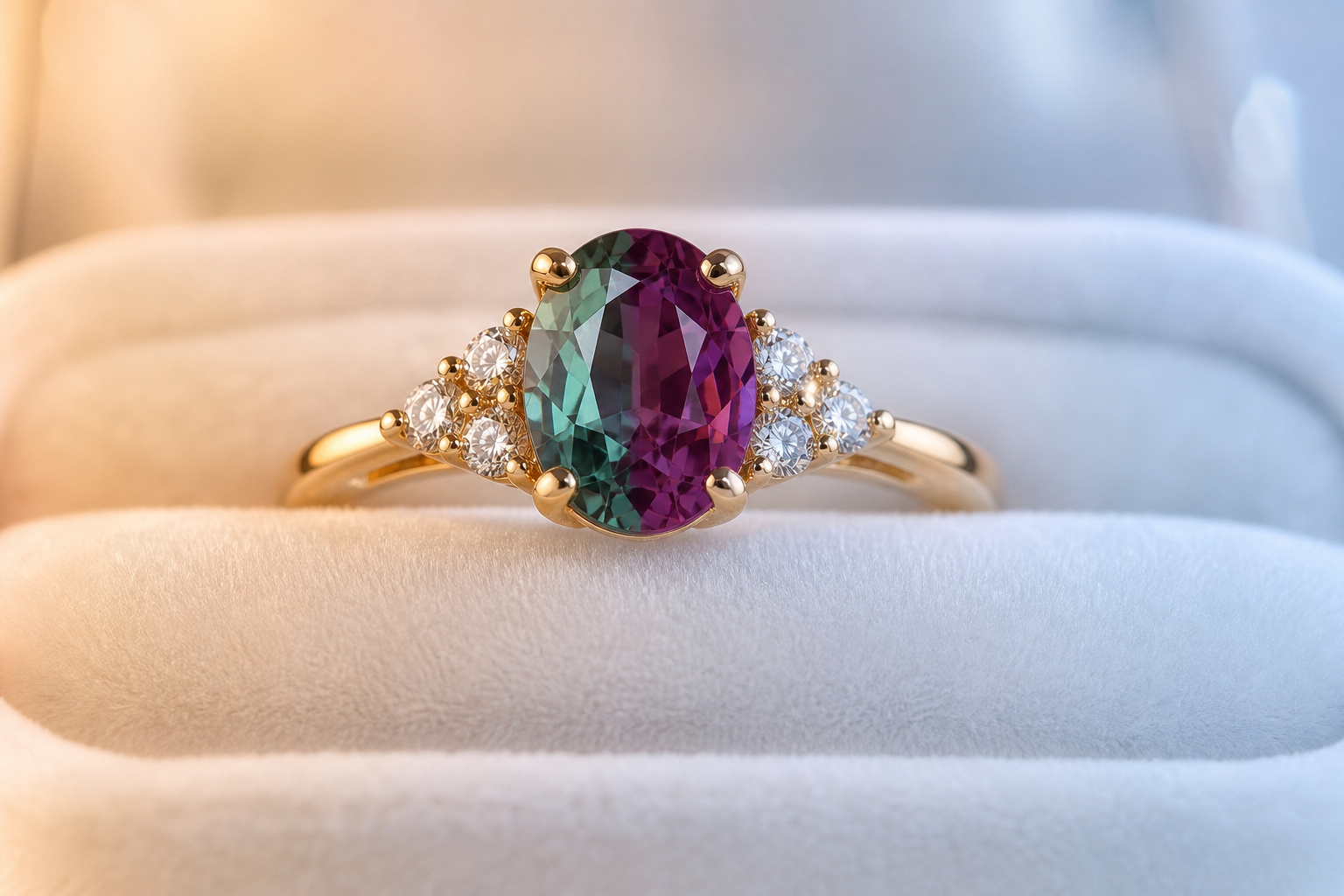
Alexandrite ring cost and the mesmerizing color-change effect make this gemstone one of the most fascinating choices for engagement rings and fine jewelry. Often described as “emerald by day, ruby by night,” alexandrite shifts dramatically between green and red depending on the light source. This rare phenomenon has captivated gem enthusiasts since the stone was first discovered in Russia in 1830.
In this complete guide, we cover everything you need to know about alexandrite rings, including how the color change works, the price difference between natural and lab-created stones, how to identify quality alexandrite, the best cuts for maximum color display, and essential care tips to keep your ring beautiful for decades.
What Is Alexandrite?
Alexandrite is a variety of the mineral chrysoberyl that contains trace amounts of chromium. This chromium is responsible for the stone remarkable color-change property, known as the “alexandrite effect.” It is one of the rarest gemstones in the world, significantly rarer than diamonds, sapphires, or rubies.
The stone was first discovered in the Ural Mountains of Russia in 1830 and was named after Czar Alexander II. Because it displayed the red and green colors of the Russian imperial flag, it quickly became the national stone of Russia and a prized possession of the aristocracy.
Today, alexandrite is found in Brazil, Sri Lanka, East Africa, and India, though Russian deposits are largely exhausted. The combination of extreme rarity, stunning beauty, and fascinating optical properties makes alexandrite one of the most coveted gemstones among collectors and jewelry lovers.
How the Alexandrite Color-Change Effect Works
The alexandrite ring color change is not magic, though it certainly looks like it. The phenomenon occurs because of how chromium atoms within the crystal structure interact with different wavelengths of light.
The Science Behind the Shift
Chromium in alexandrite absorbs light in the yellow portion of the visible spectrum. This creates a transmission window that allows both green and red wavelengths to pass through. Which color you see depends on the light source illuminating the stone.
Daylight and fluorescent light: These sources are rich in blue and green wavelengths. Under this lighting, the green transmission dominates, and alexandrite appears green, teal, or bluish-green.
Incandescent light (candles, tungsten bulbs): These sources are rich in red wavelengths. Under warm artificial light, the red transmission dominates, and alexandrite appears red, purplish-red, or raspberry.
The strength of the color change varies between stones. The finest alexandrite shows a vivid, complete shift from pure green to pure red. Lesser stones may show a partial change, perhaps shifting from yellowish-green to brownish-red. The more dramatic and complete the color change, the more valuable the stone.
What Affects Color-Change Quality
Several factors influence how dramatic the color change appears:
Chromium concentration: Higher chromium content generally produces stronger color change, though too much can make the stone too dark.
Crystal quality: Cleaner crystals with fewer inclusions allow light to interact more effectively with the chromium, producing clearer color shifts.
Cut quality: A well-proportioned cut maximizes light interaction within the stone, enhancing the visible color change.
Stone size: Larger stones tend to display more obvious color change because there is more material for light to interact with.
Alexandrite Ring Cost: Natural vs Lab-Created
Understanding alexandrite ring cost requires distinguishing between natural and lab-created stones, as the price difference is enormous.
Natural Alexandrite Pricing
Natural alexandrite is among the most expensive gemstones in the world. Prices depend heavily on the strength of color change, overall color quality, clarity, and origin.
Low quality (weak color change, included): $500 to $3,000 per carat
Medium quality (moderate color change, slightly included): $5,000 to $15,000 per carat
High quality (strong color change, eye-clean): $15,000 to $50,000 per carat
Exceptional quality (vivid green-to-red, clean, Russian origin): $50,000 to $100,000+ per carat
A 1-carat natural alexandrite engagement ring with good color change can easily cost $10,000 to $30,000 for the stone alone. Stones over 2 carats with strong color change are museum-quality rarities that command extraordinary prices.
Lab-Created Alexandrite Pricing
Lab-created alexandrite offers the same chemical composition and color-change properties as natural alexandrite at a dramatically lower price point.
Standard quality lab alexandrite: $50 to $200 per carat
Premium quality lab alexandrite: $200 to $800 per carat
A complete lab-created alexandrite engagement ring with a quality setting typically ranges from $300 to $2,000. This makes the alexandrite experience accessible to buyers who love the color-change effect but cannot justify the cost of natural stones.
Lab-created alexandrite is produced using methods like the Czochralski pull method or flux growth. These stones are real alexandrite (same chemical formula, same crystal structure, same color change), just grown in a laboratory rather than in the earth over millions of years.
Is Lab Alexandrite Worth It?
Absolutely. Lab-created alexandrite displays the same stunning color change as natural stones. For most wearers, the visual experience is identical. The primary reasons to choose natural over lab are collector value, investment potential, and the romance of owning something formed by nature over geological time. For pure beauty and enjoyment, lab alexandrite delivers exceptional value.
How to Identify Quality Alexandrite
Whether shopping for natural or lab-created alexandrite, knowing what to look for helps you choose the best stone for your budget.
Color Change Strength
This is the single most important quality factor. Look for stones that show a distinct, obvious shift between two clearly different colors. The ideal is green to red, but blue-green to purple-red is also highly valued. Avoid stones that only shift slightly or show muddy, brownish tones in either lighting condition.
Color Saturation
Beyond the change itself, the richness of each color matters. Vivid, saturated greens and reds are more valuable than pale or grayish versions of those colors. The stone should look beautiful in both lighting conditions, not just one.
Clarity
Alexandrite commonly contains inclusions due to its formation conditions. Eye-clean stones (no visible inclusions without magnification) command premium prices. However, minor inclusions that do not affect the color change or overall beauty are acceptable, especially in natural stones where perfect clarity is extremely rare.
Cut Quality
A well-cut alexandrite maximizes both color change and brilliance. Look for even color distribution across the face of the stone, good light return, and pleasing proportions. Poorly cut stones may show color zoning (patches of different color) or appear dark and lifeless.
Distinguishing Natural from Synthetic
For buyers concerned about authenticity, professional gemological testing is essential for natural alexandrite purchases. Key indicators include:
Inclusions: Natural alexandrite typically contains characteristic inclusions like fingerprint patterns, silk (fine needle-like inclusions), and crystal inclusions. Lab stones tend to be much cleaner or contain different inclusion types (gas bubbles, curved striae).
Certification: Always request a certificate from a reputable gemological laboratory (GIA, AGL, Gubelin, or SSEF) for natural alexandrite purchases, especially for stones over 1 carat.
Best Cuts for Alexandrite Rings
The cut you choose affects how dramatically the color change displays and how the stone looks on your finger.
Oval Cut
The most popular cut for alexandrite. Oval shapes maximize carat weight retention from rough material and display color change beautifully across a large face-up area. The elongated shape also flatters the finger.
Cushion Cut
Cushion cuts combine the brilliance of a round with the elegance of a square shape. The rounded corners and larger facets create broad flashes of color that showcase the color-change effect dramatically.
Round Brilliant
Round cuts maximize light return and brilliance. While they waste more rough material (making natural round alexandrite more expensive per carat), they display the color change evenly from all angles.
Emerald Cut
Step-cut emerald shapes offer a different aesthetic, showing the color change in broad, mirror-like flashes rather than the scattered sparkle of brilliant cuts. This cut works well for those who prefer understated elegance and want to appreciate the color itself rather than sparkle.
Pear and Marquise
These elongated fancy shapes maximize the apparent size of the stone and create a dramatic look on the finger. They can show beautiful color change but require careful cutting to avoid dark or light areas at the points.
Alexandrite Engagement Ring Settings
The right setting enhances alexandrite beauty while protecting this precious stone.
Solitaire
A solitaire setting puts all attention on the alexandrite itself, allowing the color change to be the star. This is ideal for high-quality stones with strong color change that do not need accent stones to impress.
Halo
A halo of small diamonds or white sapphires around the alexandrite adds sparkle and makes the center stone appear larger. The white accent stones also provide a neutral backdrop that lets the alexandrite color change stand out more dramatically.
Three-Stone
Flanking the alexandrite with two accent stones (diamonds, sapphires, or smaller alexandrites) creates a balanced, classic look. Some designs use green and red accent stones to echo the two colors of the alexandrite.
Vintage-Inspired
Alexandrite has a historical, romantic quality that pairs beautifully with vintage-inspired settings featuring milgrain, filigree, and detailed metalwork. Art Deco and Victorian-inspired designs complement the stone old-world charm.
Caring for Your Alexandrite Ring
Alexandrite is relatively durable with a hardness of 8.5 on the Mohs scale, making it suitable for daily wear. However, proper care ensures your ring stays beautiful.
Daily Wear Guidelines
Alexandrite is hard enough for everyday engagement ring wear. It resists scratching from most common materials. However, it can still be chipped by sharp impacts, so remove your ring during activities that risk hard knocks, like heavy lifting, sports, or working with tools.
Cleaning
Clean alexandrite with warm water, mild dish soap, and a soft brush. Rinse thoroughly and dry with a lint-free cloth. Ultrasonic cleaners are generally safe for alexandrite unless the stone has significant fractures or has been fracture-filled. Steam cleaning is also acceptable for untreated stones.
Storage
Store your alexandrite ring separately from other jewelry to prevent scratching softer stones. A fabric-lined box or individual soft pouch works well. While alexandrite is hard, it can be scratched by diamond or sapphire if stored together.
Professional Maintenance
Have your ring inspected by a jeweler annually to check prong integrity and ensure the stone is secure. This is especially important for prong-set alexandrite, as worn prongs can lead to stone loss.
Alexandrite vs Other Color-Change Stones
Alexandrite is not the only color-change gemstone, but it is the most famous and dramatic. Here is how it compares to alternatives:
Color-change sapphire: Shows a blue-to-purple shift. Less dramatic than alexandrite but more affordable in natural form and very durable (9 Mohs).
Color-change garnet: Some garnets shift from green to red, similar to alexandrite. These are rare and can be quite valuable, though typically less vivid than fine alexandrite.
Color-change diaspore (Zultanite): Shifts from kiwi green to champagne to raspberry. Softer than alexandrite (6.5-7 Mohs) and less dramatic in its change.
None of these alternatives match the vivid green-to-red shift of fine alexandrite, which is why it remains the undisputed king of color-change gemstones.
Is an Alexandrite Engagement Ring Right for You?
An alexandrite engagement ring is perfect for someone who loves surprises and the idea of a ring that looks different throughout the day. It suits those who appreciate rarity and want something most people have never seen in person. It is ideal for anyone who values uniqueness over convention and wants a ring that sparks conversation.
With lab-created options making the alexandrite experience affordable, there is no reason to miss out on this extraordinary gemstone if it speaks to you.
Explore Alexandrite Rings at ETYGEM
Discover the magic of color-change gemstones in our alexandrite ring collection featuring 7 carefully curated designs. Each ring showcases the remarkable green-to-red shift that makes alexandrite unlike any other gemstone.
For more inspiration on choosing an alexandrite engagement ring, read our detailed Alexandrite Engagement Ring Guide covering styles, settings, and shopping tips. Whether you are drawn to the science of color change, the romance of a rare gemstone, or simply the beauty of a stone that transforms before your eyes, alexandrite offers an engagement ring experience like no other.
Frequently Asked Questions
How much does a real alexandrite ring cost?
Natural alexandrite is extremely rare and expensive: $5,000-$70,000+ per carat for fine quality. Lab-created alexandrite offers the same color-change effect for $30-$150 in sterling silver settings. Lab alexandrite has identical chemical composition (chrysoberyl) and optical properties.
Does alexandrite really change color?
Yes. Alexandrite shifts from green/blue-green in daylight to red/purple-red under incandescent light. This happens because alexandrite absorbs light differently depending on the light source’s spectrum. The effect is dramatic and visible to the naked eye in quality stones.
Is alexandrite durable enough for daily wear?
Absolutely. Alexandrite rates 8.5 on the Mohs hardness scale, making it one of the hardest colored gemstones. It’s harder than emerald (7.5-8) and nearly as hard as sapphire (9). It’s an excellent choice for engagement rings worn daily.
Is lab-created alexandrite “real”?
Lab-created alexandrite is chemically identical to natural alexandrite (both are chrysoberyl, BeAl2O4 with chromium). It displays the same color-change phenomenon. The only difference is origin: lab vs earth. Gemologically, it’s classified as “real alexandrite, lab-created origin.”
The Enchanting Allure of the Alexandrite Ring: A Journey into Color and Elegance
Imagine holding a gemstone that defies expectations — a jewel that shifts seamlessly from shades of rich green to deep red, depending on the light. This is the mesmerizing world of the alexandrite ring, a piece of jewelry that marries rarity with incredible beauty. It’s no exaggeration to say that an this color-changing gem ring isn’t just an accessory; it’s an experience, an expression of elegance that holds a whisper of mystique and intrigue.
The Discovery and History of Alexandrite
The story of alexandrite begins in 1830, when the gemstone was first discovered in the Ural Mountains of Russia near the Tokovaya River. According to the Gemological Institute of America (GIA), the stone was named after Czar Alexander II of Russia because it was discovered on his birthday. Its colors — green and red — mirrored the imperial Russian military colors, making it an instant national treasure.
The International Gem Society (IGS) documents that the original Russian deposits were largely exhausted by the end of the 19th century, making specimens from this source extremely valuable to collectors. Today, alexandrite is found in Brazil, Sri Lanka, East Africa, and India, though none match the quality of the finest Russian stones. Research published in Gems & Gemology journal confirms that Brazilian alexandrites from Hematita, Minas Gerais, discovered in 1987, represent the most significant find since the original Russian deposits.