

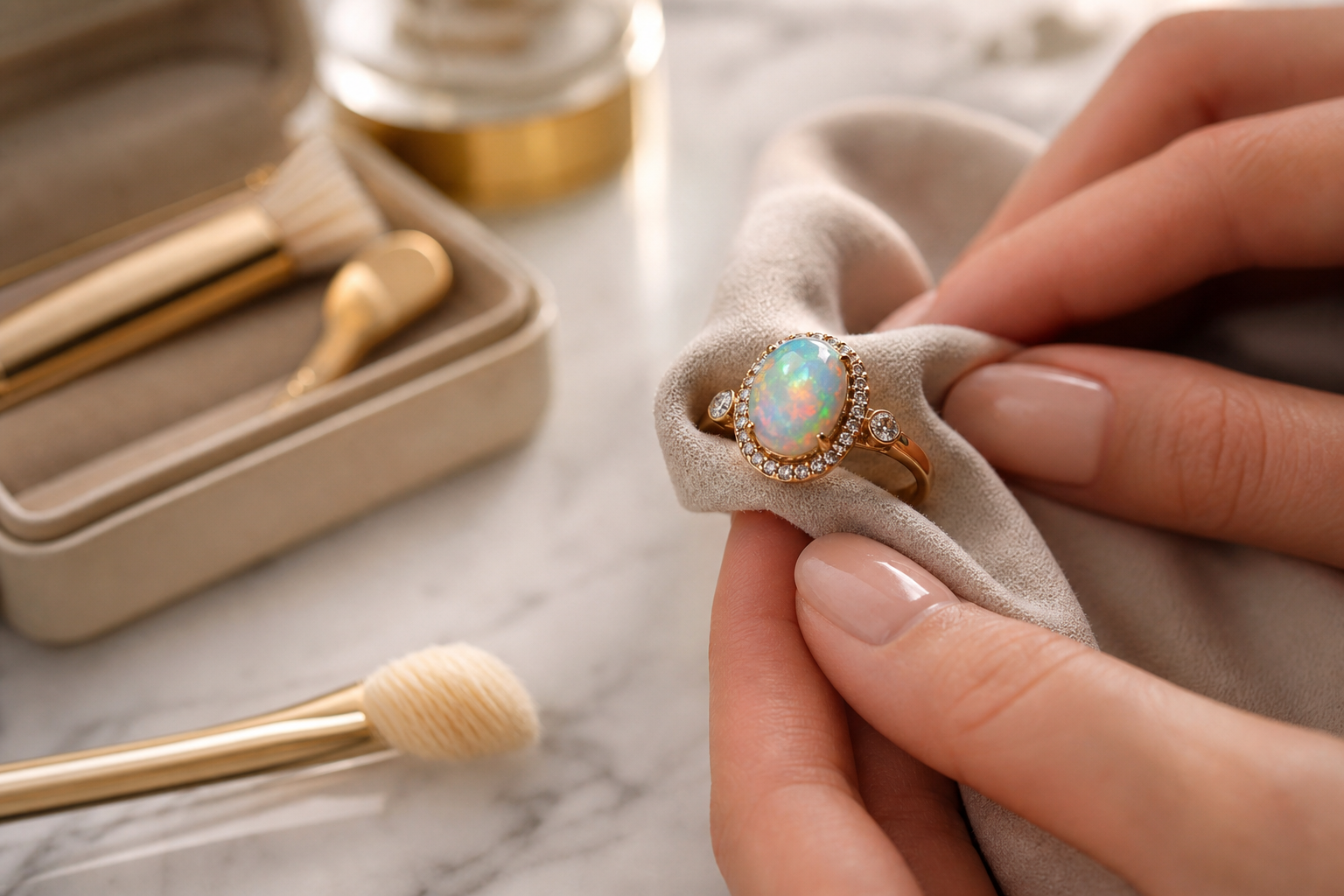
Can You Wear an Opal Ring Every Day?
Yes — with the right care. Opal rings are beautiful but require more attention than harder gemstones like sapphire or diamond. Opal rates 5.5-6.5 on the Mohs hardness scale and contains 3-21% water, making it sensitive to extreme conditions.
The good news? Thousands of people wear opal rings daily without issues. The key is understanding what to avoid and developing simple habits that protect your stone.
How to Clean Your Opal Ring
The Safe Method (Weekly)
- Fill a small bowl with lukewarm water (never hot)
- Add a tiny drop of mild dish soap
- Soak the ring for 2-3 minutes maximum
- Gently brush with a very soft toothbrush
- Rinse under lukewarm running water
- Pat dry immediately with a soft, lint-free cloth
What NOT to Do
- ❌ Never use ultrasonic cleaners — vibrations can crack opal
- ❌ Never use steam cleaners — extreme heat damages opal
- ❌ Never soak for extended periods — water absorption can cause crazing
- ❌ Never use chemicals — bleach, ammonia, and alcohol damage the surface
- ❌ Never use abrasive cloths — they scratch the softer surface
5 Things That Damage Opal Rings
1. Extreme Temperature Changes
Opal contains water. Rapid temperature shifts (hot car → air-conditioned room) can cause the stone to crack or “craze” (develop fine surface lines). Avoid leaving your ring in direct sunlight or near heat sources.
2. Chemicals & Cleaning Products
Household cleaners, perfume, hairspray, and even hand sanitizer can dull or damage opal. Always remove your ring before cleaning, applying beauty products, or using hand sanitizer.
3. Physical Impact
Opal is relatively soft. Banging it against hard surfaces (countertops, weights at the gym) can chip or crack the stone. Remove before any physical activity.
4. Prolonged Water Exposure
While brief cleaning is fine, extended soaking (swimming pools, hot tubs, long baths) can cause water absorption that leads to crazing over time. Chlorinated and salt water are especially harmful.
5. Dry Storage Conditions
Ironically, opal also doesn’t like being too dry. If stored in a safe deposit box or very dry environment for months, the water content can evaporate. Store with a small damp cotton ball nearby for long-term storage.
Daily Wear Tips for Opal Rings
Follow the “last on, first off” rule:
- Put your opal ring on last — after applying makeup, perfume, and sunscreen
- Take it off first — before washing hands, cooking, cleaning, or exercising
Safe Activities
- ✅ Office work and typing
- ✅ Light shopping and socializing
- ✅ Dining out
- ✅ Driving (with care)
Remove Your Ring For
- ⚠️ Washing dishes or cleaning
- ⚠️ Gym, yoga, or sports
- ⚠️ Swimming or bathing
- ⚠️ Gardening or manual work
- ⚠️ Applying lotions or perfume
How to Store Your Opal Ring
- Store in a soft cloth pouch or lined jewelry box
- Keep separate from harder gemstones (diamonds, sapphires will scratch opal)
- Avoid airtight containers — opal needs some humidity
- For long-term storage, place a slightly damp cotton ball in the box
- Keep away from direct sunlight and heat sources
When to Get Professional Help
Take your opal ring to a jeweler if you notice:
- Fine cracks or “crazing” on the surface
- The stone becoming loose in its setting
- Significant dulling that home cleaning doesn’t fix
- Any chips or damage to the stone
A professional can re-polish minor surface scratches and check that prongs are secure.
Shop Opal Rings at ETYGEM
All ETYGEM opal rings are set in protective sterling silver settings designed for daily wear. Our most popular styles:
- Classic Blue Opal Ring — Elegant everyday design
- Heart Opal Ring — Romantic heart-shaped stone
- Adjustable Opal Ring — One size fits all
Free worldwide shipping. 6-month warranty. Hypoallergenic and nickel-free.
Frequently Asked Questions
Can I wash my hands with an opal ring on?
Quick hand washing with mild soap is generally fine. However, avoid hot water and harsh soaps. If you wash hands frequently (healthcare workers, food service), it’s better to remove the ring. Hand sanitizer’s alcohol content can dull opal over time.
How often should I clean my opal ring?
A gentle cleaning once a week is sufficient for daily-wear rings. Use lukewarm water, a drop of mild dish soap, and a very soft brush. Never soak for more than 2-3 minutes. For rings worn occasionally, clean before and after each wearing.
Can opal crack on its own?
Opal can develop “crazing” (fine surface cracks) if exposed to rapid temperature changes or extremely dry conditions. This is rare with proper care. Store your ring away from heat sources and direct sunlight. If you live in a very dry climate, store with a slightly damp cotton ball nearby.
Does opal lose its color over time?
No. Opal’s play of color is a permanent optical property caused by its internal structure. It cannot fade from light exposure or age. If your opal appears duller, it likely has surface scratches that a jeweler can re-polish to restore the original brilliance.
7 Tips for Spotting a Genuine Opal Ring
1. Analyze the Play-of-Color
A genuine opal’s play-of-color is its most defining feature. Look for a vibrant, multi-directional flash of spectral colors that appears to roll and shift as you move the stone under light. Imitations, such as “opalite” (a man-made glass), often display a milky, static sheen or a uniform “flash” that lacks depth and movement.
2. Check for Imperfections and Inclusions
Natural opals are formed by nature and frequently contain minor imperfections. You may see small inclusions, slight color zoning, or a varied body tone. A stone that is perfectly uniform in color and pattern, with no internal characteristics, is often a sign of a synthetic lab-created opal.
3. Perform the “Hot Pin” Test (With Caution)
This is a classic, though potentially damaging, test. Only attempt this on an inconspicuous area if you are the owner.* Heat a needle or pin until it is very hot and gently touch it to the stone. A genuine opal, being a mineral, will not melt or emit a plastic odor. An imitation made of plastic will melt and smell acrid. Note: This test is not recommended for doublets or triplets, as the adhesive layer can be damaged.
4. Feel the Temperature
Natural gemstones feel cool to the touch initially. Hold the opal against your cheek or lip. A genuine opal will feel noticeably cool and take a moment to warm up. Many imitations, especially plastic, will feel closer to room temperature or warm up almost instantly.
5. Examine the Setting and Price
Assess the ring’s overall craftsmanship and price point. Genuine opal rings are typically set in quality metals like sterling silver, gold, or platinum. A very low price for a large, colorful opal is a major red flag. Authentic opals with vibrant play-of-color command a higher market value.
6. Look for a “Lizard Skin” or “Columnar” Pattern
Under 10x magnification, some genuine opals can exhibit a distinctive internal structure. A “lizard skin” or honeycomb pattern is often visible in the play-of-color. Many synthetic opals, however, display a more regular “columnar” or “snakeskin” pattern that is a tell-tale sign of laboratory creation.
7. Seek Professional Verification
When in doubt, the most reliable method is to consult a certified gemologist or a reputable, independent jewelry appraiser. They have the tools and expertise to perform definitive tests, such as measuring specific gravity and refractive index, providing a conclusive authentication report.
—
Related Articles
Continue reading for more gemstone guides: