

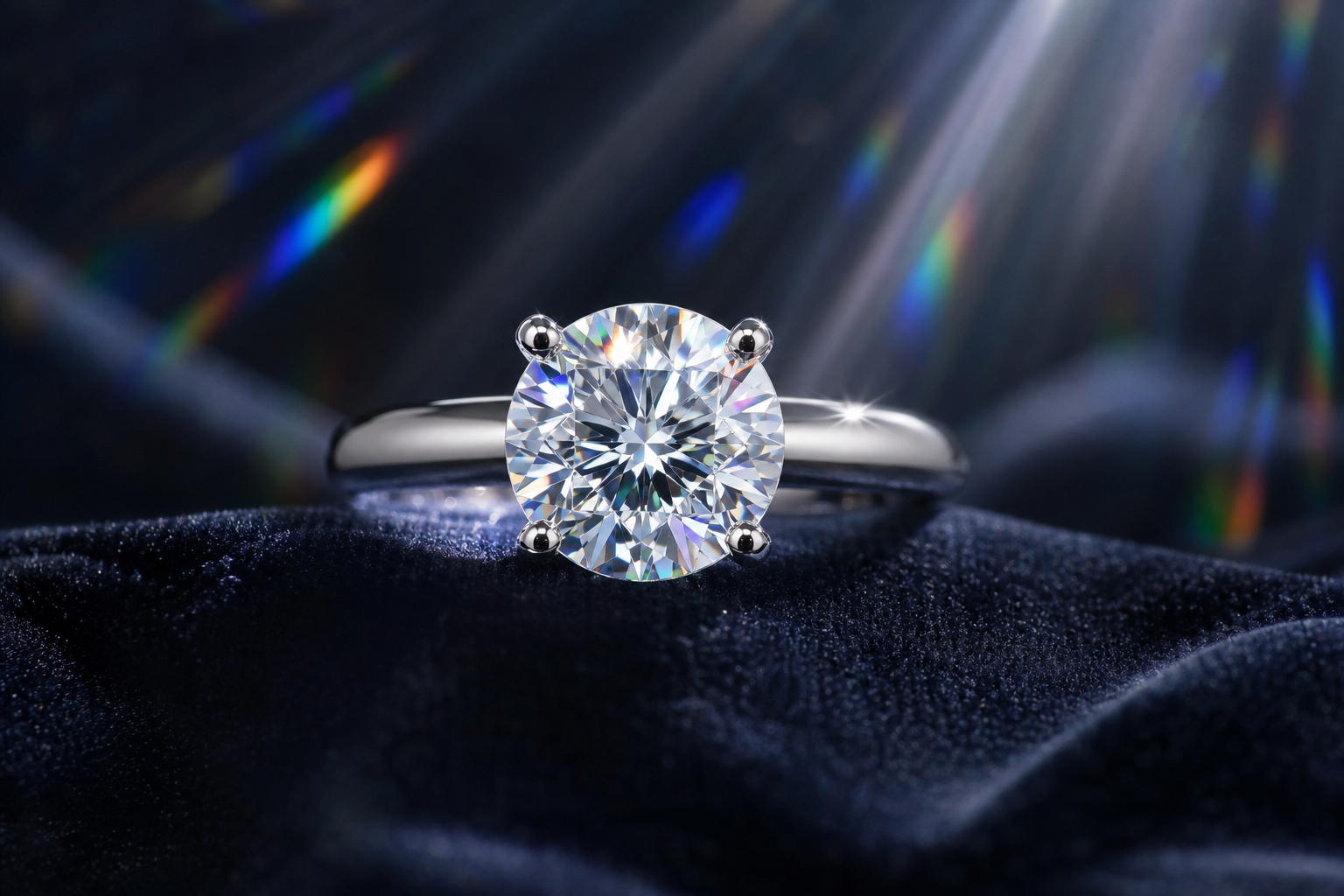
Moissanite vs Diamond: The Key Differences
Choosing between moissanite and diamond for your engagement ring? You’re not alone — moissanite has become the fastest-growing diamond alternative, and for good reason. Here’s an honest, side-by-side comparison to help you decide.
| Property | Moissanite | Diamond |
|---|---|---|
| Brilliance (Refractive Index) | 2.65 ✨ Higher | 2.42 |
| Fire (Dispersion) | 0.104 🔥 More rainbow flashes | 0.044 |
| Hardness (Mohs) | 9.25 | 10 |
| Price (1ct equivalent) | $50-$150 | $3,000-$15,000+ |
| Origin | Lab-created | Mined or lab-created |
| Ethical concerns | None | Conflict mining risk |
| Resale value | Low | Moderate |
Why Moissanite Actually Sparkles More Than Diamond
This surprises most people: moissanite has more brilliance and fire than diamond. Its higher refractive index (2.65 vs 2.42) means it bends more light, creating more sparkle. Its higher dispersion (0.104 vs 0.044) means it splits light into more rainbow colors.
In practical terms: a moissanite ring catches the eye more in any lighting condition. Some people love this extra sparkle; others prefer diamond’s more subtle light return. It’s a matter of personal taste, not quality.
Is Moissanite as Durable as Diamond?
Nearly. At 9.25 on the Mohs scale, moissanite is the second hardest gemstone used in jewelry (diamond is 10). For practical purposes:
- ✅ Won’t scratch from any everyday material
- ✅ Safe for daily wear, including hand washing
- ✅ Won’t cloud, fade, or lose brilliance over time
- ✅ Lifetime durability — passes the “forever” test
The only thing that can scratch moissanite is diamond itself. For an engagement ring worn daily for decades, moissanite performs identically to diamond in durability.
The Price Difference: Where Your Money Goes
A 1-carat diamond engagement ring typically costs $3,000-$15,000+. A visually identical moissanite ring? $50-$300 in sterling silver, or $200-$800 in gold.
That’s not a quality difference — it’s a supply/demand difference. Diamonds are expensive because of controlled supply and marketing (thank De Beers). Moissanite is affordable because it’s efficiently lab-created with no artificial scarcity.
What could you do with the savings?
- Put it toward your honeymoon
- Save for a house down payment
- Buy a complete jewelry set (ring + earrings + necklace)
- Invest it for your future together
Can People Tell It’s Not a Diamond?
In most cases, no. Even jewelers need specialized equipment to distinguish moissanite from diamond. The main visual difference:
- Moissanite — More rainbow flashes (fire), especially in sunlight
- Diamond — More white light return, subtler sparkle
To the untrained eye, moissanite looks like a very high-quality diamond. Most people will simply compliment your “beautiful diamond ring.”
When to Choose Moissanite
- You want maximum sparkle and brilliance
- Budget matters (or you’d rather spend elsewhere)
- Ethical sourcing is important to you
- You want a larger stone without the massive price tag
- You value practicality over tradition
When to Choose Diamond
- Tradition and symbolism matter most to you
- You want potential resale value
- You prefer subtler, less “fiery” sparkle
- Your partner specifically wants a diamond
Moissanite Engagement Ring Styles
Round Brilliant
The classic choice. Round moissanite maximizes the stone’s natural brilliance and fire, creating an eye-catching sparkle that rivals any diamond.
Oval Cut
Elongated and flattering on the finger. Oval moissanite appears larger than round stones of the same carat weight.
Princess Cut
Modern and geometric. The square shape with brilliant faceting is perfect for contemporary ring designs.
Tennis Bracelets
Moissanite truly shines in tennis bracelets — a continuous line of brilliant stones that would cost $20,000+ in diamond but under $200 in moissanite.
Shop Moissanite Rings at ETYGEM
Our moissanite collection features D-color (colorless), VVS clarity stones in 925 sterling silver settings. Every stone is certified and comes with a lifetime brilliance guarantee.
- Delicate Moissanite Solitaire Ring — Classic elegance
- 0.5ct Moissanite Ring — Perfect everyday sparkle
- Browse all 78 moissanite rings →
Also explore our moissanite tennis bracelets — stunning brilliance at unbeatable prices.
Free worldwide shipping. 6-month warranty. Hypoallergenic and nickel-free.
Frequently Asked Questions
Can a jeweler tell the difference between moissanite and diamond?
Not by eye alone. Jewelers need a specialized moissanite tester or loupe examination to distinguish them. Standard diamond testers often identify moissanite as diamond because both conduct heat similarly. Only electrical conductivity testing reliably separates them.
Does moissanite lose its sparkle over time?
No. Moissanite’s brilliance is a permanent property of its crystal structure (silicon carbide). It will not cloud, yellow, or lose sparkle with age. This is one of its key advantages over cubic zirconia, which does degrade over time.
Is moissanite considered “fake”?
No. Moissanite is a real gemstone with its own identity (silicon carbide, first discovered in a meteor crater in 1893). It’s not an imitation diamond. It’s a distinct gemstone that happens to share some visual similarities with diamond while having its own superior optical properties.
Will moissanite pass a diamond tester?
Most basic thermal diamond testers will read moissanite as “diamond” because both stones conduct heat well. Only newer dual-testing devices (thermal + electrical) can distinguish them. This is why many people choose moissanite with confidence that it’s visually indistinguishable in everyday settings.