

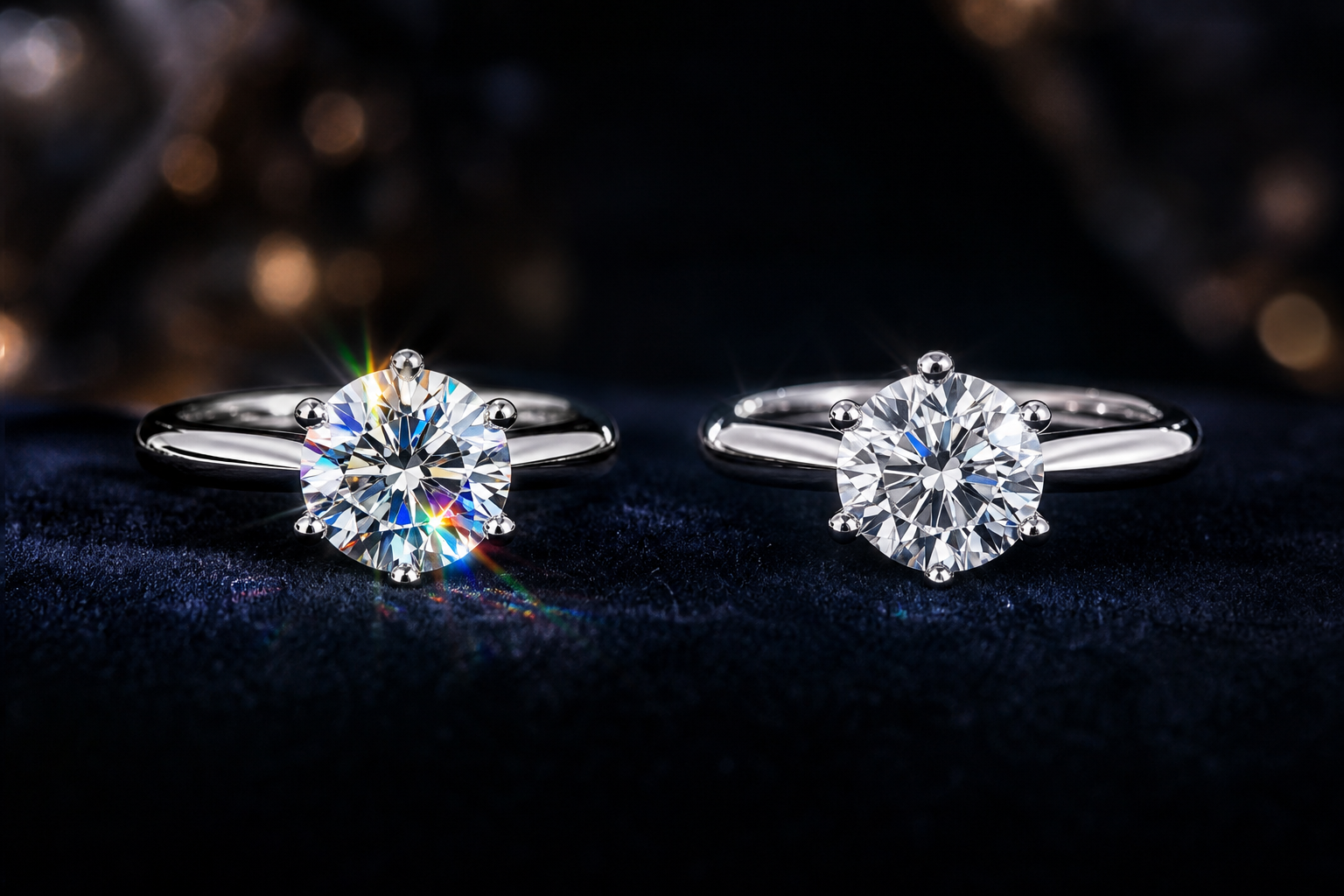
Moissanite vs lab diamond is one of the most common comparisons shoppers face when looking for a beautiful, ethical, and affordable engagement ring or fine jewelry piece. Both stones offer stunning brilliance without the ethical concerns of mined diamonds, but they differ significantly in price, optical properties, hardness, and long-term value.
If you are trying to decide between moissanite vs lab grown diamond for your next jewelry purchase, this guide covers everything you need to know. We compare these two popular stones across every factor that matters, so you can choose with confidence.
What Is Moissanite?
Moissanite was first discovered in 1893 by French chemist Henri Moissan in a meteor crater in Arizona. Natural moissanite is incredibly rare, so virtually all moissanite sold today is lab-created silicon carbide (SiC). It was introduced to the jewelry market in the late 1990s as a diamond alternative and has grown steadily in popularity ever since.
Modern moissanite is engineered to be colorless or near-colorless, with exceptional brilliance that actually exceeds diamond in some measurable ways. It is not a “fake diamond” or simulant in the traditional sense. It is its own gemstone with distinct optical and physical properties.
What Is a Lab-Grown Diamond?
Lab-grown diamonds (also called lab-created, synthetic, or cultured diamonds) are real diamonds produced in controlled laboratory environments. They have the exact same chemical composition (pure carbon), crystal structure, and physical properties as mined diamonds. The only difference is their origin.
Two methods produce lab diamonds: High Pressure High Temperature (HPHT) and Chemical Vapor Deposition (CVD). Both create genuine diamonds that are optically, chemically, and physically identical to natural diamonds. Even gemologists cannot distinguish them without specialized equipment.
Moissanite vs Lab Diamond: Detailed Comparison
Price Comparison
The moissanite vs lab diamond price difference is substantial and often the deciding factor for buyers.
Moissanite: A 1-carat equivalent moissanite typically costs between $300 and $600 for premium quality. A 2-carat equivalent ranges from $500 to $1,000. Prices remain relatively stable regardless of size increases.
Lab Diamond: A 1-carat lab-grown diamond with good specifications (G-H color, VS clarity, excellent cut) typically costs between $800 and $2,500. A 2-carat lab diamond ranges from $2,000 to $6,000. Prices increase significantly with size.
On average, moissanite costs about 70% to 85% less than a comparable lab-grown diamond. For budget-conscious buyers, this difference is enormous. A moissanite ring that looks virtually identical to a diamond ring on the finger can save thousands of dollars.
Brilliance and Sparkle
This is where the comparison gets interesting, because moissanite actually outperforms diamond in measurable brilliance.
Refractive Index: Moissanite has a refractive index of 2.65 to 2.69, compared to diamond at 2.42. This higher refractive index means moissanite bends light more, creating more internal brilliance.
Fire (Dispersion): Moissanite has a dispersion of 0.104, compared to diamond at 0.044. This means moissanite produces more than twice the rainbow flashes (fire) that diamond does. In direct sunlight, moissanite creates dramatic rainbow sparkles that some people love and others find “too much.”
Lab Diamond: Displays the classic diamond sparkle, a balanced combination of white light return (brilliance) and rainbow flashes (fire). The sparkle is what most people picture when they think of a diamond ring.
The visual difference is subtle in smaller stones (under 1 carat) but becomes more noticeable in larger sizes. Moissanite tends to show more colorful flashes, while diamond shows more white light brilliance. Neither is better, it is purely a matter of preference.
Hardness and Durability
Moissanite: 9.25 on the Mohs hardness scale. This makes it the second hardest gemstone used in jewelry, harder than sapphire and ruby. It is extremely scratch-resistant and suitable for everyday wear without concern.
Lab Diamond: 10 on the Mohs hardness scale. Diamond remains the hardest known natural material. It is virtually impossible to scratch under normal wearing conditions.
In practical terms, both stones are excellent for daily wear engagement rings. The difference between 9.25 and 10 is negligible for real-world durability. Both will maintain their polish and clarity for a lifetime without visible wear.
Color
Moissanite: Premium moissanite (DEF color grade equivalent) appears colorless in most lighting. However, some moissanite can show a slight yellow or greenish tint under certain lights, particularly in larger sizes. This has improved dramatically with modern production techniques, and top-quality moissanite is virtually indistinguishable from colorless diamond to the naked eye.
Lab Diamond: Graded on the same D-to-Z color scale as natural diamonds. You can select your exact color preference. A G or H color lab diamond faces up white and offers excellent value.
Clarity
Moissanite: Most moissanite is produced with very high clarity, equivalent to VS or better. Needle-like inclusions can occasionally be present but are typically invisible without magnification.
Lab Diamond: Graded on the standard clarity scale (FL to I3). Lab diamonds can have inclusions just like natural diamonds, though the types may differ slightly. A VS2 or SI1 lab diamond is typically eye-clean.
Resale Value
Moissanite: Has minimal resale value. If you tried to sell a moissanite ring, you would likely recover only a small fraction of the purchase price. However, given the low initial cost, this is less of a concern for most buyers.
Lab Diamond: Currently has limited resale value compared to natural diamonds. The lab diamond market is still maturing, and prices have been declining as production scales up. Resale typically returns 20% to 40% of the original purchase price.
Neither stone should be considered an investment. If resale value is a priority, natural diamonds (while more expensive) hold their value better than either option.
When to Choose Moissanite
Moissanite is the better choice when:
Budget is a priority. If you want maximum size and sparkle for minimum cost, moissanite delivers incredible value. You can get a large, stunning stone for under $1,000.
You love extra sparkle. If you are drawn to rainbow fire and dramatic light performance, moissanite actually outperforms diamond in this regard.
Size matters to you. Because moissanite is so affordable, you can go bigger without financial strain. A 2 or 3-carat equivalent moissanite costs less than a 1-carat lab diamond.
You prioritize ethics and sustainability. While both options are ethical, moissanite production has an even smaller environmental footprint than lab diamond production.
You do not care about “real diamond” status. If the cultural significance of having a “real” diamond does not matter to you, moissanite offers comparable beauty at a fraction of the price.
When to Choose Lab Diamond
Lab-grown diamond is the better choice when:
You want a real diamond. Lab diamonds are chemically, physically, and optically identical to mined diamonds. If having a genuine diamond matters to you (for personal or cultural reasons), lab-grown delivers that at 60% to 80% less than mined.
You prefer classic diamond sparkle. If the rainbow fire of moissanite feels “too much” and you prefer the balanced white brilliance of diamond, lab-grown is your match.
Maximum hardness matters. For those who are very hard on their jewelry or work in demanding environments, diamond at 10 Mohs offers the ultimate in scratch resistance.
You want diamond certification. Lab diamonds come with grading reports from GIA, IGI, or other labs, providing objective quality documentation that moissanite does not have in the same standardized way.
Tradition is important. If you or your partner value the tradition and symbolism specifically associated with diamonds, a lab-grown diamond honors that tradition ethically and affordably.
Can People Tell the Difference?
In everyday situations, no. The average person cannot distinguish moissanite from diamond on someone finger. Even many jewelers cannot tell without testing equipment. The differences in sparkle pattern are subtle and only noticeable when you know exactly what to look for, typically by comparing the stones side by side under specific lighting.
Between lab diamond and natural diamond, the distinction is even harder. They are literally the same material. No one can tell a lab diamond from a mined diamond by looking at it.
The Verdict: Which Offers Better Value?
If “value” means getting the most beauty for your money, moissanite wins decisively. You get a stone that is nearly as hard as diamond, more brilliant than diamond, and costs 70% to 85% less.
If “value” means getting a real diamond at the best possible price, lab-grown diamond wins. You get an authentic diamond at 60% to 80% less than mined, with identical properties and appearance.
Both are excellent choices. Neither is “settling.” The best choice is the one that aligns with your priorities, whether those are budget, tradition, sparkle preference, or simply what makes you smile when you look at your hand.
Shop Moissanite Jewelry at ETYGEM
Explore our stunning collection of moissanite rings featuring 78 designs that showcase the incredible brilliance of this remarkable stone. From classic solitaires to elaborate halo settings, each piece is crafted to maximize moissanite natural fire and sparkle.
For those who love the look of moissanite beyond rings, browse our moissanite tennis bracelets collection with 48 stunning designs. A moissanite tennis bracelet offers the same dazzling sparkle as diamond at a price that makes luxury accessible. Whether you are shopping for an engagement ring or building your fine jewelry collection, moissanite delivers extraordinary beauty and value.
Frequently Asked Questions
Is moissanite better than lab-grown diamond?
“Better” depends on your priorities. Moissanite offers more sparkle (higher refractive index) at 1/10th the price. Lab diamond offers identical properties to mined diamond with better resale potential. For pure visual impact per dollar, moissanite wins. For traditional expectations, lab diamond wins.
Can you tell moissanite from lab diamond?
In most lighting conditions, no. The main visible difference: moissanite produces more rainbow flashes (fire) in direct sunlight, while lab diamond produces more white light return. Under indoor lighting, they’re virtually indistinguishable to the naked eye.
Do lab diamonds hold value better than moissanite?
Slightly, but neither holds value well compared to natural diamonds. Lab diamonds typically resell for 20-30% of purchase price. Moissanite has minimal resale value. If investment potential matters, neither is ideal. Both are best viewed as personal purchases rather than investments.
Which is more ethical: moissanite or lab diamond?
Both are ethical choices with zero mining impact. Both are created in controlled laboratory environments. The environmental footprint is similar. Choose based on aesthetics and budget rather than ethics, as both score equally well on sustainability.