

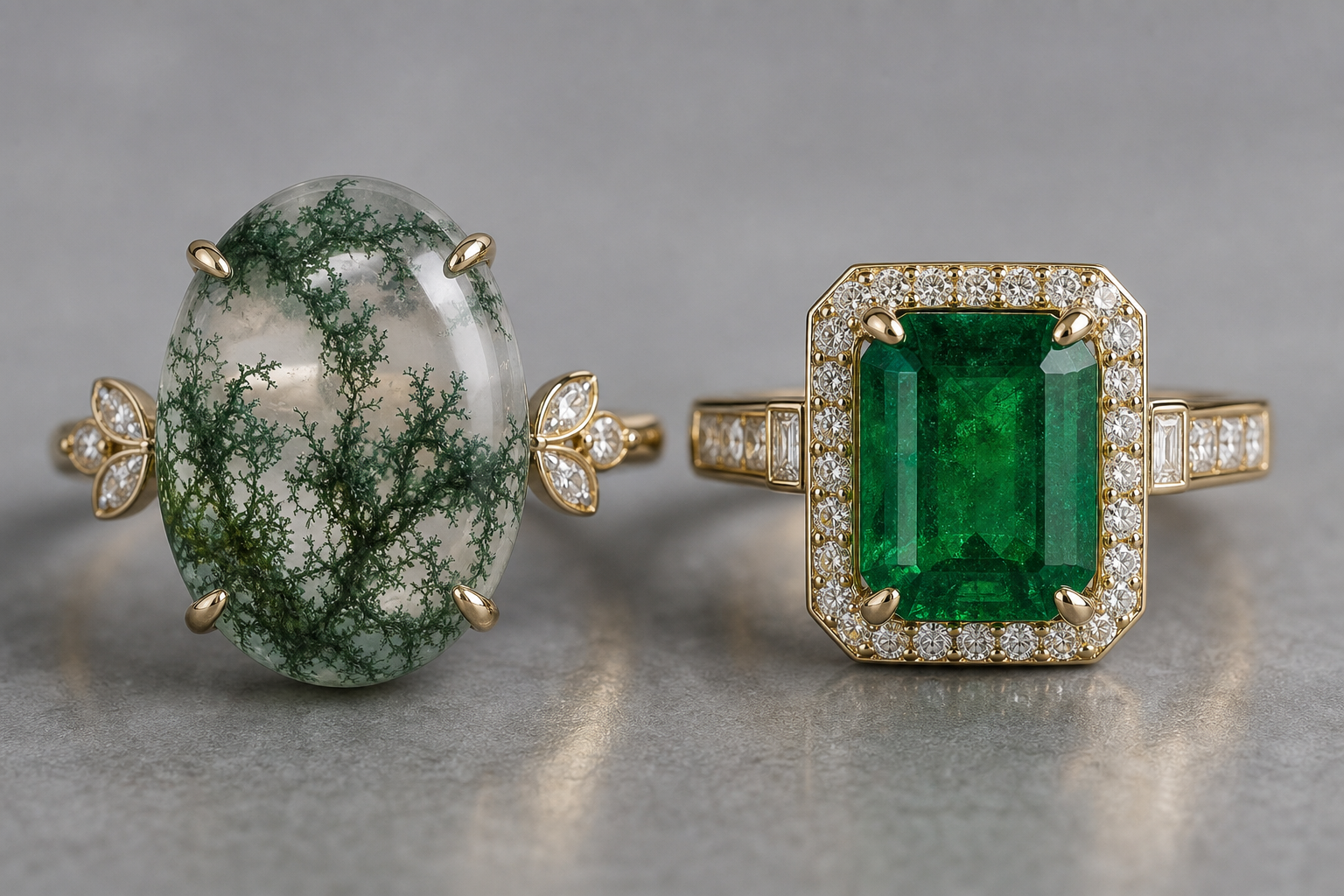
Choosing between a moss agate ring and an emerald ring is one of the most common dilemmas for green gemstone lovers. Both stones deliver stunning shades of green, but they differ dramatically in appearance, durability, price, and symbolism. Whether you’re shopping for an engagement ring, a statement piece, or an everyday accessory, understanding these differences helps you make a confident decision.
According to the Gemological Institute of America (GIA), emerald is a variety of beryl colored by chromium and vanadium, while moss agate is a chalcedony variety with dendritic inclusions of manganese and iron oxides. Despite both appearing green, their geological origins, optical properties, and practical characteristics couldn’t be more different.
Moss Agate vs Emerald: Appearance Comparison
Moss Agate’s Organic Beauty
Moss agate is truly nature’s abstract art. Rather than a uniform green color, it features translucent to opaque white or clear chalcedony with green, brown, and sometimes red dendritic inclusions that resemble moss, ferns, trees, or underwater landscapes. No two stones are identical — each tells its own visual story.
Key visual characteristics of moss agate:
- Translucent to opaque body with internal “garden” patterns
- Green colors from chlorite and hornblende mineral inclusions
- Cut as cabochons (smooth, domed) to showcase internal patterns
- Refractive index: 1.53–1.54
- No sparkle or brilliance — beauty comes from depth and pattern
Emerald’s Classic Luxury
Emerald delivers a completely different aesthetic — rich, saturated green with crystalline transparency and the subtle glow known as “jardin” (garden), which refers to the natural inclusions that give each this green beryl character. Fine emeralds exhibit a velvety, almost electric green that has symbolized luxury for millennia.
Key visual characteristics of emerald:
- Transparent to translucent with vivid green saturation
- Color from chromium and/or vanadium trace elements
- Faceted cuts (emerald cut, oval, round) to maximize color and light return
- Refractive index: 1.57–1.58
- Subtle brilliance with characteristic inclusions (“jardin”)
Durability: Which Green Gemstone Lasts Longer?
This is where the comparison gets surprising. Despite emerald being technically harder, moss agate is actually the more durable choice for everyday ring wear.
Hardness Comparison
- Moss Agate: 6.5–7 on the Mohs scale
- Emerald: 7.5–8 on the Mohs scale
Emerald wins on scratch resistance. However, the International Gem Society (IGS) emphasizes that hardness is only one component of durability.
Toughness: The Critical Difference
Here’s where moss agate dramatically outperforms emerald:
- Moss Agate toughness: Excellent — microcrystalline structure resists chipping and breaking
- Emerald toughness: Poor to fair — natural inclusions and fractures make emeralds notoriously brittle
Emeralds are among the most fragile precious gemstones. Their internal fractures (which nearly all natural emeralds contain) create weakness points where the stone can chip or crack from moderate impact. The American Gem Society notes that emeralds require significantly more careful handling than most colored gemstones.
Moss agate’s interlocking microcrystalline structure, by contrast, distributes stress evenly throughout the stone. It’s remarkably resistant to chipping, cracking, and breaking — making it far more practical for rings worn daily.
Stability and Treatments
Nearly all commercial emeralds (estimated 95%+) are treated with oils or resins to fill surface-reaching fractures and improve clarity. These treatments can degrade over time, requiring re-treatment. Moss agate is typically untreated and completely stable — what you see is what you get, permanently.
Price Comparison: Moss Agate vs Emerald Rings
The price difference between these two green gemstones is enormous:
Moss Agate Pricing
- Loose stones: $2–$30 per carat
- Finished rings (sterling silver): $30–$150
- Finished rings (14k gold): $200–$800
- High-end custom designs: $500–$1,500
Emerald Pricing
- Commercial grade: $200–$2,000 per carat
- Fine quality: $3,000–$10,000 per carat
- Top Colombian/Zambian: $10,000–$50,000+ per carat
- Finished rings: $500–$50,000+ depending on stone quality
A stunning moss agate ring costs roughly what a mediocre emerald stone alone would cost. This price difference reflects the gemstone’s rarity and historical prestige rather than any inherent superiority in beauty — both stones are gorgeous in their own right.
Symbolism and Meaning
Moss Agate Symbolism
Moss agate has been associated with:
- New beginnings and growth
- Connection to nature and the earth
- Emotional balance and stability
- Abundance and prosperity (historically used by farmers)
- Grounding and tranquility
Emerald Symbolism
Emerald carries centuries of symbolic weight:
- Love, rebirth, and fertility (Cleopatra’s favorite stone)
- Wisdom and patience
- Royalty and luxury
- May birthstone
- 20th and 55th wedding anniversary stone
Both stones symbolize growth and renewal, but emerald carries more traditional prestige while moss agate resonates with modern values of individuality and nature connection.
Best Uses for Each Green Gemstone Ring
Choose Moss Agate When You Want:
- A unique, one-of-a-kind ring with organic patterns
- Maximum durability for everyday wear
- An affordable ring that looks expensive
- A nature-inspired aesthetic
- An ethical, sustainable gemstone choice
- A large center stone without a large price tag
Browse our collection of moss the stone rings for unique, handcrafted designs.
Choose Emerald When You Want:
- Classic luxury and timeless prestige
- A transparent, faceted gemstone with brilliance
- Traditional symbolism and recognition
- A May birthstone ring
- Investment-grade gemstone value
- A ring that commands immediate recognition
Explore our emerald ring collection for elegant designs at accessible prices.
Setting and Style Recommendations
Best Settings for Moss Agate Rings
Since moss agate is cut as a cabochon, it pairs beautifully with:
- Bezel settings that frame the stone like a miniature painting
- Nature-inspired bands with vine or leaf motifs
- Rose gold or yellow gold for warm, earthy aesthetics
- Minimalist solitaire designs that let the pattern speak
Best Settings for Emerald Rings
Faceted emeralds shine in:
- Classic emerald-cut solitaires (the cut was literally named for this stone)
- Three-stone settings with diamond side stones
- Halo designs that protect edges while adding sparkle
- Yellow gold settings that enhance the green warmth
Care Requirements Compared
According to Gems & Gemology, both stones require care but at different levels:
Moss Agate Care (Moderate)
- Clean with warm soapy water and soft brush
- Store separately from harder stones
- Remove for heavy physical work
- No special treatments needed — ever
Emerald Care (High Maintenance)
- Clean only with warm soapy water — never ultrasonic or steam cleaners
- Avoid all chemicals, including hand sanitizer
- Remove for any physical activity
- May need re-oiling every few years to maintain appearance
- Handle with extra care — brittle and chip-prone
- Insure the ring — replacement costs are significant
The Verdict: Which Green Gemstone Ring Is Better?
Neither stone is objectively “better” — they serve different purposes and appeal to different values:
Moss agate is better for: Daily wear, budget-conscious buyers, nature lovers, those who value uniqueness, and anyone wanting a low-maintenance ring that can handle real life.
Emerald is better for: Special occasion wear, those who value tradition and prestige, collectors, May birthstone celebrations, and anyone willing to invest in careful maintenance for classic luxury.
Many jewelry lovers ultimately own both — a moss agate ring for everyday beauty and an emerald for special occasions. They complement rather than compete with each other.
Frequently Asked Questions
Is moss agate more durable than emerald for daily wear?
Yes, for practical daily wear, moss agate is more durable than emerald despite being slightly softer on the Mohs scale (6.5–7 vs 7.5–8). The critical difference is toughness: this green gem’s microcrystalline structure resists chipping and breaking far better than this precious stone, which is notoriously brittle due to internal fractures. For a ring worn every day, this chalcedony is the safer choice.
Why is emerald so much more expensive than moss agate?
Emerald’s high price reflects its geological rarity, historical prestige, and the difficulty of finding stones with good color, clarity, and size. Fine emeralds form under very specific geological conditions and large, clean specimens are exceptionally rare. Moss agate is relatively abundant and doesn’t carry the same historical luxury associations, keeping prices accessible despite its genuine beauty.
Can moss agate look as good as emerald in a ring?
They offer different types of beauty that aren’t directly comparable. Moss agate won’t replicate emerald’s transparent, saturated green glow — but this green beryl can’t replicate this natural mineral’s unique internal landscapes either. Many people find the stone more visually interesting and personal than this verdant gem. It’s a matter of aesthetic preference, not quality hierarchy.
Which green gemstone is better for an engagement ring?
For engagement rings specifically, moss agate offers practical advantages: superior toughness for daily wear, no maintenance treatments needed, affordable replacement if ever damaged, and guaranteed uniqueness. Emerald engagement rings are beautiful but require more careful handling and carry higher replacement costs. If you want worry-free daily wear, choose this chalcedony. If you prioritize prestige and don’t mind extra care, choose the gemstone.
Do moss agate and emerald pair well together in jewelry?
Absolutely. The combination of moss agate’s organic patterns with emerald’s crystalline green creates stunning contrast in multi-stone designs. Some jewelers create rings with a this green gem center stone accented by small this precious stone side stones, or vice versa. The complementary greens — one organic and patterned, one pure and saturated — work beautifully together.