

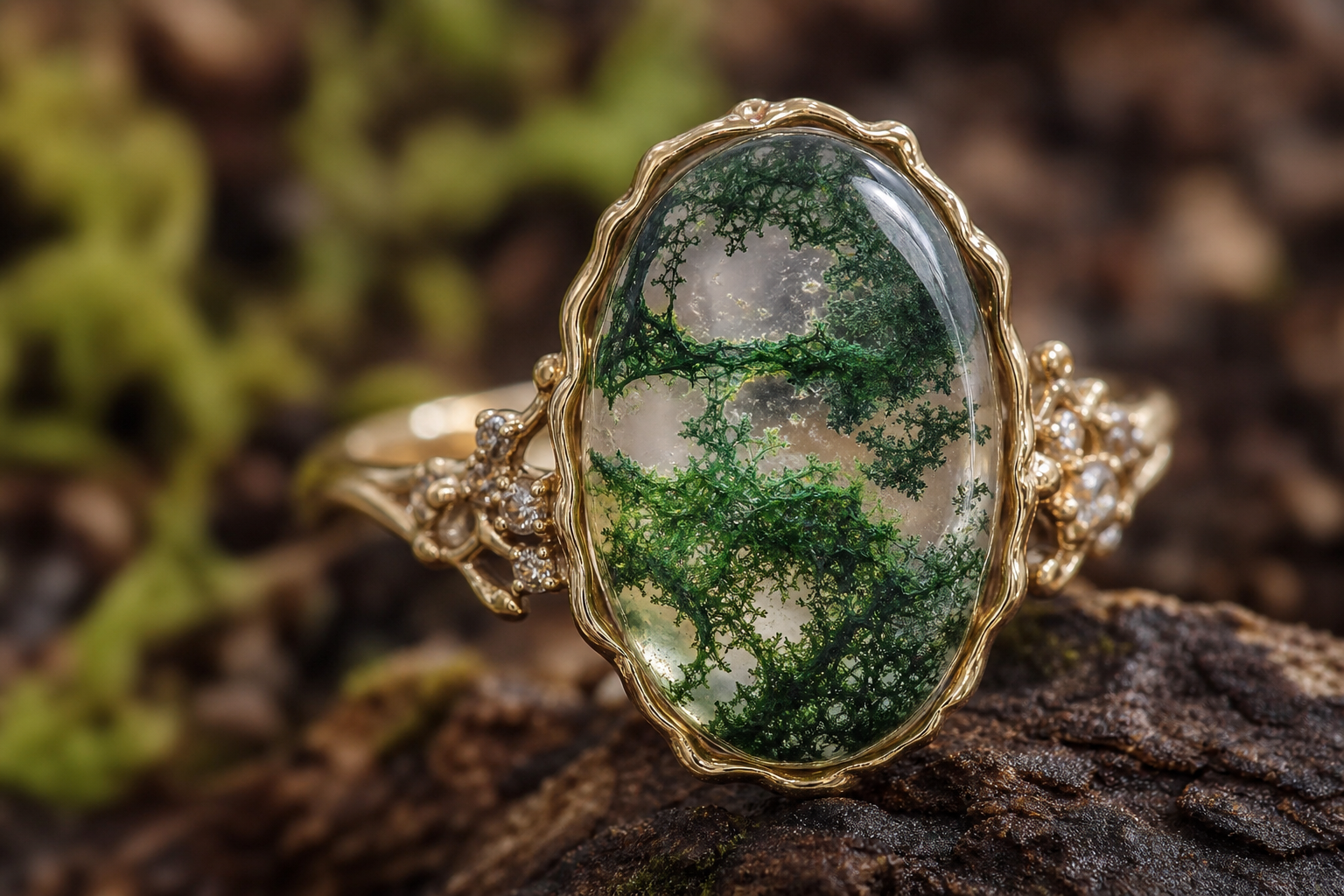
Green gemstones have captivated jewelry lovers for centuries. Two of the most popular choices for rings today are moss agate and emerald — both stunning, both green, yet worlds apart in origin, price, and character. If you’re torn between these two beauties, this guide breaks down everything you need to know.
What Is Moss Agate?
Moss agate is a form of chalcedony (a variety of quartz) with green, brown, or black mineral inclusions that resemble moss, ferns, or trees trapped inside the stone. Despite its name, it contains no actual organic matter — the “moss” patterns come from iron or manganese oxides.
Each moss agate is completely unique. No two stones share the same pattern, making every moss agate ring a one-of-a-kind piece. It’s found in India, Brazil, Uruguay, and the United States.
What Is Emerald?
Emerald is a variety of the mineral beryl, colored green by trace amounts of chromium and sometimes vanadium. It’s one of the “Big Four” precious gemstones alongside diamond, ruby, and sapphire. Fine emeralds come from Colombia, Zambia, Brazil, and Ethiopia.
Emeralds have been prized since ancient Egypt — Cleopatra famously adored them. Today, a high-quality emerald ring remains one of the most coveted pieces in fine jewelry.
Moss Agate vs Emerald: Side-by-Side Comparison
| Property | Moss Agate | Emerald |
|---|---|---|
| Mineral Family | Chalcedony (Quartz) | Beryl |
| Mohs Hardness | 6.5–7 | 7.5–8 |
| Color Range | Translucent with green/brown inclusions | Vivid green to bluish-green |
| Transparency | Translucent to opaque | Transparent to translucent |
| Luster | Waxy to vitreous | Vitreous |
| Price (per carat) | $2–$30 | $200–$18,000+ |
| Durability for Daily Wear | Good (tough, no cleavage) | Moderate (often has inclusions that weaken structure) |
| Rarity | Common | Rare (fine quality very rare) |
| Treatment | Usually untreated | Almost always oiled or filled |
| Birthstone Month | Not traditional | May |
Color: Nature’s Art vs Pure Green Fire
Moss agate offers an organic, earthy aesthetic. The green inclusions float inside a translucent or milky white base, creating landscapes that look like miniature forests. Some stones lean more toward deep green, others show lighter sage tones with brown accents.
Emerald delivers a bold, saturated green that’s hard to match. The finest emeralds show a pure green hue with strong saturation and medium-dark tone. Colombian emeralds tend toward a warm, slightly yellowish green, while Zambian stones lean cooler and bluish.
Durability: Which Lasts Longer?
Here’s where things get interesting. Emerald is harder on the Mohs scale (7.5–8 vs 6.5–7), but hardness isn’t the whole story.
Emeralds are notoriously included — the French call these internal features “jardins” (gardens). These inclusions, combined with the stone’s brittleness, make emeralds more prone to chipping and cracking than their hardness number suggests. That’s why most emeralds are treated with oil or resin to fill surface-reaching fractures.
Moss agate, while softer, is actually tougher in practice. Chalcedony has no cleavage planes, meaning it doesn’t split along flat surfaces when struck. For everyday ring wear, moss agate can be surprisingly resilient.
Price: Budget-Friendly vs Investment Piece
The price gap between these two stones is enormous:
- Moss agate rings: $50–$500 for most finished pieces
- Emerald rings: $500–$50,000+ depending on quality
A 1-carat moss agate cabochon might cost $5–$20. A 1-carat emerald of decent quality starts around $500 and can reach $18,000+ per carat for top Colombian stones. This makes moss agate one of the most accessible gemstone rings on the market.
Symbolism & Meaning
Moss agate is associated with nature, growth, new beginnings, and abundance. Crystal healers connect it to the heart chakra and believe it promotes emotional balance and connection to the earth. It’s sometimes called the “gardener’s stone.”
Emerald symbolizes rebirth, love, wisdom, and fertility. Ancient Romans dedicated it to Venus, the goddess of love. It’s long been associated with royalty, wealth, and eternal spring.
When to Choose Moss Agate
- You want a unique, nature-inspired ring that nobody else will have
- Your budget is under $500
- You prefer organic, earthy aesthetics over traditional sparkle
- You want something durable enough for daily wear without worrying
- You love the idea of a stone that looks like a tiny landscape
- You’re drawn to alternative or bohemian jewelry styles
When to Choose Emerald
- You want a classic, prestigious gemstone with centuries of history
- Bold, saturated green is your color
- You’re looking for a May birthstone ring
- Budget isn’t a primary concern
- You appreciate transparent stones with depth and brilliance
- You want a ring that holds or increases in value over time
Can You Tell Them Apart at a Glance?
Absolutely. These stones look nothing alike in person. Moss agate is translucent with visible internal patterns — it looks like a tiny terrarium. Emerald is transparent (or semi-transparent) with a uniform green color and visible facets that catch light.
The confusion only exists on paper because both are “green gemstones.” In reality, choosing between them is more about aesthetic preference than comparing similar options.
Care & Maintenance
Moss agate care: Clean with warm soapy water and a soft brush. Avoid ultrasonic cleaners. Store separately to prevent scratching by harder stones. No special treatments needed.
Emerald care: Clean gently with warm soapy water only — never use ultrasonic or steam cleaners (they can remove the oil treatment). Avoid sudden temperature changes. Have the stone re-oiled by a jeweler every few years if it looks dry.
Setting Styles That Work Best
Moss agate looks best in:
- Bezel settings (protects the stone and frames the pattern)
- Rose gold or yellow gold (complements the earthy tones)
- Cabochon cuts (shows off the internal patterns)
- Nature-inspired settings with leaf or vine details
Emerald looks best in:
- Prong settings (maximizes light entry)
- Yellow gold or platinum (classic pairing)
- Emerald cut, oval, or cushion shapes
- Halo settings for extra protection and sparkle
Frequently Asked Questions
Is moss agate a good engagement ring stone?
Yes. With a hardness of 6.5–7 and excellent toughness, moss agate holds up well for daily wear. It’s become increasingly popular for engagement rings, especially among couples who want something unique and meaningful without a massive price tag.
Are emeralds too fragile for everyday wear?
Emeralds require more care than diamonds or sapphires, but millions of people wear emerald rings daily. Choose a protective setting (bezel or halo), avoid impacts, and remove the ring during heavy manual work.
Which holds its value better?
Emerald, without question. Fine emeralds are rare and their value has consistently increased over decades. Moss agate is affordable but doesn’t appreciate in value the same way. If investment potential matters, emerald wins.
Can moss agate look like emerald?
No. They have completely different appearances. Moss agate has visible internal patterns and is usually cut as a cabochon. Emerald is transparent, faceted, and uniformly green. They’re not substitutes for each other — they’re different aesthetic choices.
Which is more ethical/sustainable?
Moss agate generally has a smaller environmental footprint. It’s abundant, requires less intensive mining, and is rarely associated with conflict. Emerald mining can have significant environmental and social impacts, though certified ethical sources exist (look for Muzo or RJC certification).
The Bottom Line
Moss agate and emerald serve different purposes and appeal to different tastes. Moss agate is the choice for nature lovers who want an affordable, unique, and durable green stone. Emerald is for those who want prestige, tradition, and that unmistakable rich green fire.
Neither is objectively “better” — it depends entirely on your priorities: budget, style, durability needs, and what the ring means to you. Browse our moss agate ring collection or emerald ring collection to see both options in person.